Introduction
Roofing contractors who offer strong warranty programs close more deals, retain more customers, and generate more revenue. Homeowners expect manufacturers to stand behind their materials, but increasingly, they're asking who covers the installation.
Will leaks from flashing errors be covered? What happens if nail patterns fail during the first storm? These questions come up, and how you answer them determines whether you close the deal or lose it to a competitor who can.
Which warranty program you choose determines where the money goes. Every $15,000 roof includes warranty fees. The question is whether those fees build equity in your business or flow straight into a third party's pocket.
This blog covers which warranty program partners best serve roofing businesses looking to protect their customers, reduce risk, and run a more profitable operation. Shingle warranties for homeowners are a different conversation entirely.
TL;DR
- Roofing businesses choose from manufacturer-backed programs (GAF, Owens Corning, CertainTeed), third-party administrators, or contractor-owned reinsurance models
- Manufacturer programs offer brand credibility but cap your profit potential — the manufacturer keeps the margin
- Third-party administrators reduce administrative burden while underwriting profits flow to the administrator, not you
- Established contractors earn the most by owning their own reinsurance-backed warranty company — capturing premiums and controlling claims
- Your choice depends on business size, growth goals, and how much underwriting profit you're prepared to hand over to someone else
What Roofing Businesses Should Look for in a Warranty Program
A warranty program must serve two core functions: protecting the customer by covering materials and workmanship defects, and protecting the contractor by managing financial exposure from claims. The strongest programs accomplish both — and return real money to the contractor for quality work.
The Three Warranty Program Models
Roofing contractors have three primary program options:
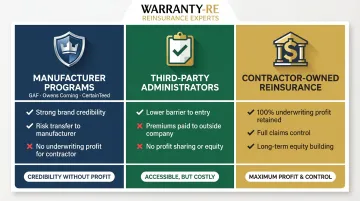
- Manufacturer Certification Programs (GAF, Owens Corning, CertainTeed): Tiered certifications unlock increasingly powerful warranties and transfer workmanship risk to the manufacturer — but come with certification fees, volume commitments, and brand lock-in that limit flexibility.
- Third-Party Warranty Administrators (such as RWC): Lower barrier to entry than manufacturer programs. Contractors offer branded warranty products without certification, but pay ongoing premiums to an outside company and keep none of the underwriting profit.
- Contractor-Owned Reinsurance Models: The contractor establishes their own reinsurance company — backed by A-rated insurers — collects the premiums, controls claims decisions, and retains 100% of underwriting profits. This model builds equity in the business over time, which the other two do not.
Understanding these models upfront matters, because the way most contractors actually choose a program is where things go wrong.
The Biggest Mistake Roofing Businesses Make
Most contractors choose warranty programs based on name recognition alone — without asking who keeps the profits, who controls claims, or whether the program builds any long-term equity for their business. With approximately 109,000 roofing businesses competing in a $92.5 billion market, warranty differentiation matters — but so does whether your warranty program makes you money or just costs you money.
Best Warranty Companies for Roofing Businesses
This list evaluates warranty companies based on coverage depth, profit structure for the contractor, administrative support, and long-term business value — not just brand recognition.
GAF Certified Contractor Programs
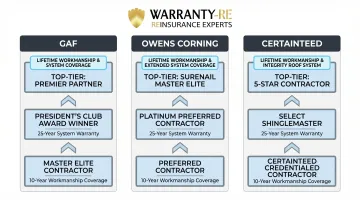
GAF is North America's largest roofing manufacturer. Their contractor certification tiers — from Certified to Master Elite (top ~2% of contractors) — unlock increasingly powerful warranty programs roofing businesses can offer customers. These programs help contractors win premium-priced jobs and stand apart from competitors who can only offer standard coverage.
Key program features roofing businesses should know:
- Tiered certification unlocks progressively stronger warranty products
- WindProven coverage eliminates wind speed limits entirely
- Manufacturer-backed workmanship coverage reduces the contractor's direct claims exposure
- Top-tier access requires ongoing CARE training and customer satisfaction scores
| Program Tier | Warranty Offered to Customers | Profit Structure for Contractor |
|---|---|---|
| GAF Certified | System Plus Limited Warranty (materials only) | No underwriting profit share; annual membership fees + per-warranty registration fees |
| Master Elite | Silver Pledge (10-year workmanship) or Golden Pledge (25-30 year workmanship with 40-point factory inspection) | Same fee structure; all underwriting profit retained by GAF |
| WindProven | 15-year wind coverage with no maximum wind speed limitation | Requires qualifying GAF system; no profit participation |
The Golden Pledge warranty is GAF's flagship offering, requiring a mandatory factory inspection by a GAF field technician to verify the roof meets manufacturer specifications. Only 2% of roofing contractors qualify for Master Elite status due to stringent financial, professional, and quality requirements.
Owens Corning Contractor Programs
Owens Corning's Platinum Preferred and Preferred Contractor programs unlock the Platinum Protection warranty — one of the strongest workmanship coverage programs available, including lifetime (50-year) manufacturer-backed workmanship coverage that roofing businesses can offer as a reason homeowners choose them over competitors.
Owens Corning brings a broad product line — including Class 4 impact-resistant shingles (Duration Storm) — strong homeowner brand recognition, and a claims process the manufacturer handles directly. Platinum Preferred requires at least 3 years in business, $2 million in liability insurance, and a rigorous third-party workmanship inspection.
| Certification Level | Warranty Unlocked | Business Benefit |
|---|---|---|
| Preferred Contractor | System Protection (50-year materials) or Preferred Protection (50 years materials + 10 years workmanship) | Claims handled by manufacturer; access to ProConnect leads, Design EyeQ, OC Rewards |
| Platinum Preferred | Platinum Protection (50 years materials + lifetime/50 years workmanship) | Manufacturer remains responsible for labor even if contractor goes out of business; full co-branding rights and marketing tools |
The Platinum Protection warranty transfers the full long-tail workmanship liability to Owens Corning, even if the contractor goes out of business. This is the strongest risk-transfer mechanism available to a roofing contractor, but comes with no underwriting profit participation.
CertainTeed Credentialing Program
CertainTeed's SELECT ShingleMaster and related credentialing tiers give roofing businesses access to the SureStart PLUS 5-Star warranty — an exclusive program available only to top credentialed installers in a region, helping contractors differentiate in competitive markets.
Three things set CertainTeed apart for roofing businesses: the regional exclusivity of the 5-Star credential, strong aesthetic product lines that support premium pricing, and 25-year workmanship coverage that builds customer trust. Maintaining credentials requires 50% of shingle crew plus all supervisors to hold Master Craftsman status.
| Credential Tier | Warranty Available to Customers | Differentiator for Contractors |
|---|---|---|
| ShingleMaster | SureStart PLUS 3-Star (20-year coverage) | Entry-level certification with basic training requirements |
| SELECT ShingleMaster | SureStart PLUS 4-Star (50-year materials, tear-off, disposal) | Requires 5 years in business or 1 year as ShingleMaster; business fiscal responsibility exam |
| 5-Star Contractor | SureStart PLUS 5-Star (50 years materials + 25-year workmanship) | Regionally exclusive/invitation-based; territorial protection; Find a Pro priority listing |
The 5-Star designation is regionally limited, preventing oversaturation and preserving the 25-year workmanship warranty as a scarce local selling advantage. This creates a territorial moat: competing contractors in the same market cannot offer the same warranty product.
Third-Party Warranty Administrators
Third-party warranty administrators (such as RWC Residential Warranty Company) allow contractors to offer branded warranty products without manufacturer certification. These programs are typically easier to access but transfer underwriting profit to the administrator.
The trade-off is straightforward: lower barrier to entry and less administrative complexity, but the contractor pays premiums to an outside company, has limited control over the claims experience, and earns no underwriting profit. This option suits smaller or newer contractors who want to offer warranties without building a program from scratch.
| Coverage Type | Program Cost to Contractor | Claims Control |
|---|---|---|
| Year 1 workmanship/materials; Years 2-5 or 10 major structural defect coverage | Annual membership fees plus per-project enrollment fees | Administrator manages all claims; contractor has minimal influence over adjudication process |
RWC, founded in 1981, has warranted over 4 million homes and holds an A- (Excellent) rating from A.M. Best. While primarily known for new home builder warranties, their Remodeler Program applies to roofing contractors performing replacements and major repairs.
WarrantyRE — Own Your Warranty Company
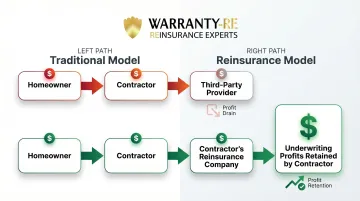
WarrantyRE has been helping contractors establish their own administrator-obligor reinsurance companies since 1994. Unlike manufacturer programs or third-party administrators, WarrantyRE helps roofing contractors replace third-party warranty providers entirely.
That shift matters financially: instead of paying premiums to an outside company, the contractor's business collects and retains those dollars.
What separates WarrantyRE from other options on this list:
- Full-service administration covering training, claims adjudication, compliance, and financials
- A-rated insurer backing for every reinsurance company established
- Tax planning benefits through IRC Section 831(b) structure
- Ability to invest accumulated premiums for additional ROI
- Complete contractor control over the claims experience, which directly affects customer satisfaction and repeat business
Under this model, roofing contractors can underwrite up to $2.85 million in net premiums annually before underwriting profit becomes subject to federal income tax, with accumulated profits taxed at capital gains rates when distributed as dividends.
| Program Model | Profit Structure | Support Provided |
|---|---|---|
| Own-your-warranty reinsurance company; contractor replaces third-party warranty providers rather than paying into them | Contractor captures 100% of underwriting profits; premiums stay in the contractor's reinsurance company rather than flowing to a manufacturer or administrator | Full-service administration including claims adjudication, compliance management, tax returns, filings, training, and performance reporting |
The warranty fee is built into the job price. On a $15,000 roof replacement, for example, that fee flows into a reinsurance account owned by the contractor's business rather than to a third-party provider.
When warranty claims arise — leaks, flashing issues, improper nail patterns — they're covered from this pool. Any unused funds remain with the contractor.
How We Chose These Companies
Our evaluation focused on factors most relevant to roofing business owners:
- Coverage depth offered to customers (material and workmanship coverage periods)
- Profit and revenue structure for the contractor (who captures underwriting gains?)
- Administrative support provided (who handles claims, compliance, filings?)
- Long-term business equity the program builds (does this increase business value?)
Most contractors evaluate warranty programs based solely on customer-facing features, overlooking whether the program actually makes their business more profitable. According to IBISWorld, approximately 109,000 roofing contractor businesses compete in a $92.5 billion market.
With over 100,000 competitors, manufacturer certification is a structural advantage — but contractors writing high install volumes are often leaving real underwriting profit on the table by staying with manufacturer or third-party programs.
The best warranty company for a roofing business is not always the most recognizable brand — it depends on the contractor's growth stage, volume, and whether they're ready to earn from their warranty program or would rather hand that profit to someone else.
Conclusion
Roofing businesses have more warranty program options than most contractors realize — from manufacturer certification tiers to third-party administrators to fully owned reinsurance companies. The right choice depends on business size, goals, and how much of the warranty profit the contractor wants to keep.
Here's how the three main options compare:
- Manufacturer programs (GAF Master Elite, Owens Corning Platinum Preferred, CertainTeed 5-Star) provide strong brand credibility and risk transfer — but the manufacturer keeps the underwriting profits
- Third-party administrators reduce your administrative burden while collecting your premium dollars year after year
- Reinsurance programs let roofing contractors own the warranty company outright and keep underwriting profits instead of paying them to someone else
If your current warranty approach sends premium dollars to a manufacturer or third-party administrator every year, those profits aren't coming back. Owning that program changes the math permanently. To explore building your own warranty company, contact WarrantyRE at (804) 824-9533.
Frequently Asked Questions
Which companies offer the best roofing warranties?
For roofing businesses, the "best" warranty company depends on the goal: GAF, Owens Corning, and CertainTeed offer strong manufacturer-backed programs that boost credibility, while reinsurance models like WarrantyRE allow contractors to own the warranty company and keep underwriting profits rather than paying them to a third party.
What is the 25% rule in roofing?
The 25% rule was a code exemption letting reroofing projects covering 25% or less of a roof area bypass full reroofing compliance. It was removed from the IBC and IRC in 2003. A separate 25% threshold still exists for parapet bracing in Seismic Design Categories D, E, and F, but this has no bearing on repair-vs.-replacement decisions.
Are there roofing products that last 80 years?
Yes. Slate (75-200+ years), copper and zinc (60-100+ years), and quality clay tile can all exceed 80 years. For contractors, this creates a real warranty gap: the material outlasts most workmanship warranties by decades, making a financially backed program that can honor long-term claims essential.
What is the difference between a manufacturer warranty and a workmanship warranty for roofing businesses?
Manufacturer warranties cover defects in materials (shingles, underlayment) and come from the product brand, while workmanship warranties cover installation errors and come from the contractor. The most competitive roofing businesses offer both, which is why the financial structure backing a contractor's warranty program directly affects what they can promise customers.
Can a roofing contractor offer their own warranty instead of using a third-party provider?
Yes, through a reinsurance model, roofing contractors can establish their own administrator-obligor warranty company — backed by A-rated insurers — that allows them to offer competitive customer warranties while capturing the underwriting profit that would otherwise go to a manufacturer or third-party administrator.