
Introduction
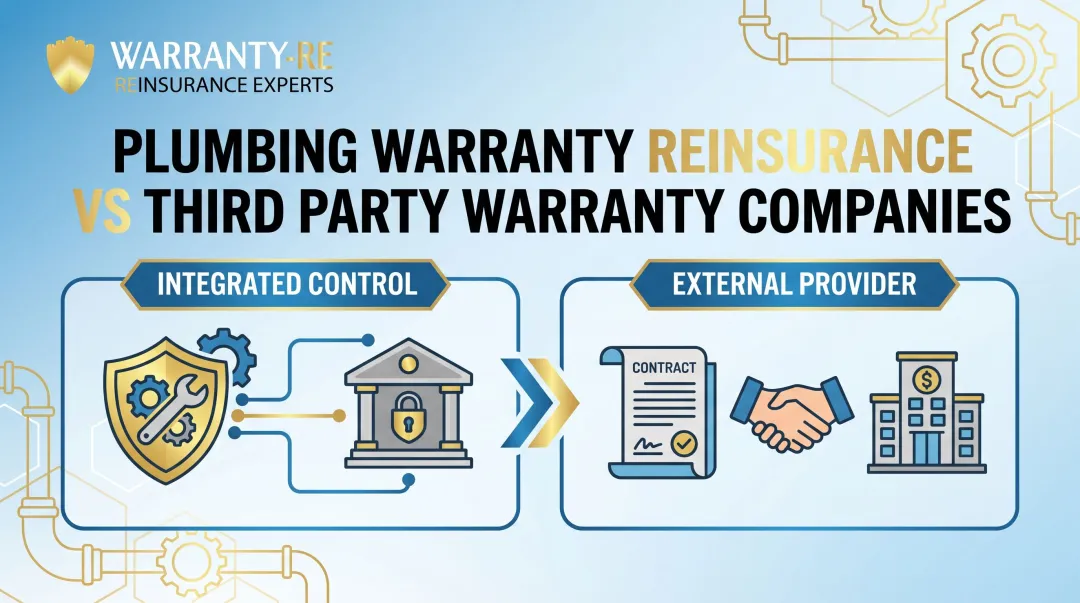
Plumbing contractors offer labor warranties to win jobs and build customer trust—but when they partner with third-party warranty providers, those providers keep 100% of the underwriting profits. The U.S. home warranty market generated $8.87 billion in revenue in 2025, and most of that flows into third-party profit centers, not contractors' pockets.
The numbers are concrete: when Frontdoor, Inc. reported its 2025 financials, just 44.7% of revenue went to actual service fulfillment. The rest covered overhead and generated profit for the warranty company—not for the plumbers doing the work.
Evaluating a plumbing warranty reinsurance program is different from comparing consumer home warranty prices. This is a B2B investment in a contractor-owned structure, and the cost depends on your business volume, program scale, coverage scope, and administrative setup. Understanding those variables is the first step toward knowing whether capturing those underwriting profits makes financial sense for your business.
TL;DR
- Typical cost structure: Ceding fees run 0–10% of premiums; administrative costs shrink as a percentage of revenue as your warranty volume grows
- Primary cost drivers: Annual warranty volume, coverage scope, claims history, and full-service versus self-administered setup
- Scale matters: Smaller operations have lower absolute costs but need volume to reach profitability; larger contractors carry higher initial reserves and capture greater profits
- Premium dollars flow into your own company, not a third party's pocket, and are offset by underwriting profits, investment income, and tax advantages
How Much Does a Plumbing Warranty Reinsurance Program Cost?
A plumbing warranty reinsurance program doesn't have a fixed price tag. Costs vary based on business volume, coverage scope, program structure, and the administrative services you select.
Contractors most often misread the numbers in three ways:
- Comparing reinsurance costs directly to third-party warranty premiums — a fundamentally different structure
- Ignoring reserves that ultimately belong to the contractor, not the provider
- Overlooking tax planning and investment income as components of net cost
When cost is misunderstood, contractors either underestimate the profitability upside or overestimate the barrier to entry. Profitable opportunities go unexplored because contractors assume reinsurance is only for large-volume operations or requires prohibitive capital. The breakdown below addresses each of those assumptions directly.
Typical Program Cost Ranges
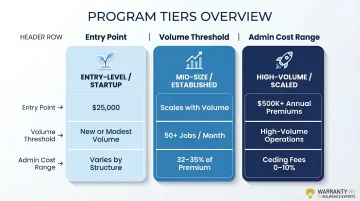
Entry-Level / Startup Program:
For plumbing contractors launching their first reinsurance-backed program, initial capitalization through captive facility structures can start as low as $25,000 (compared to traditional captive structures requiring $250,000+). Setup typically includes:
- Entity formation support and legal setup
- Basic compliance review and state filings
- Program administration framework
- Initial staff training and onboarding
This tier suits contractors new to structured warranties or those with modest install volume who are ready to transition away from third-party providers.
Mid-Size / Established Program:
Contractors doing meaningful warranty volume—50+ jobs monthly with consistent warranty fees—typically see cost structures that include:
- Full administration and claims adjudication
- Compliance management across multiple states
- Performance reporting and financial analysis
- Tax preparation coordination
Based on industry benchmarks from analogous reinsurance markets, administrative costs typically run 32-35% of premium, with the remainder representing loss funding and profit retention.
Best for: Growing plumbing businesses that want full profit capture while eliminating administrative burden.
High-Volume / Scaled Program:
Contractors with substantial annual warranty revenue ($500K+ in annual premiums) benefit from lower net costs as volume grows. At this level, reserve balances become significant business assets, investment income potential increases, and net cost as a percentage of revenue decreases. Ceding fees often range from 0-10% of premium, and contractors with strong claims management can negotiate lower rates.
Best for: Regional or multi-crew plumbing operations focused on maximizing tax advantages and building long-term business wealth.
| Program Tier | Entry Point | Volume Threshold | Admin Cost Range |
|---|---|---|---|
| Entry-Level / Startup | From $25,000 | New or modest volume | Varies by structure |
| Mid-Size / Established | Scales with volume | 50+ jobs/month | 32–35% of premium |
| High-Volume / Scaled | Lower net % at scale | $500K+ annual premiums | Ceding fees: 0–10% |
Key Factors That Affect the Cost of a Plumbing Warranty Reinsurance Program
Costs are shaped by operational, regulatory, and coverage-level factors—no two plumbing contractors will have identical program costs.
Program Structure and Type of Entity
The difference between an administrator obligor structure (where the contractor's company is the obligor, backed by A-rated insurers) and other structures affects setup cost significantly.
In this model, the administrator obligor collects premiums, investigates and settles claims, and seeks reimbursement from reinsurers. That level of control comes with a more involved setup process.
Fronting arrangements (where an A-rated company issues policies on behalf of your captive) typically carry fronting fees of 6-10% of gross written premiums and require collateral of 125-150% of projected loss funds. Simpler structures have lower upfront costs but may limit flexibility and profit retention.
Annual Warranty Sales Volume
The volume of warranties sold directly determines how much premium flows into your reserve. More volume means more reserves building, but also higher initial capitalization needs. Contractors selling fewer than 30 warranties monthly may struggle to reach break-even quickly, while those selling 100+ monthly see proportionally lower per-warranty costs.
For example: 100 jobs monthly at a $75 warranty fee generates $90,000 annually. Even after 10% ceding fees and 30% admin costs, you retain $54,000 in reserves and underwriting profits—far more than you'd keep paying a third-party provider.
Coverage Scope and Claim Risk
Plumbing-specific claim risks affect how reinsurance carriers price the risk layer above your reserve:
- Pipe failures and solder joint issues — Common callbacks with moderate repair costs
- Water heater replacements — Higher-cost claims requiring parts and labor
- Sewer line issues — Potentially catastrophic claims involving excavation and replacement
Broader coverage equals higher reinsurance costs. However, controlling service quality reduces claims—HVAC contractors with callback rates of 2-2.5% are considered well-managed, and plumbing contractors can achieve similar results through quality control and proper installation protocols.
Program Administration and Support Level
Full-service administration—covering claims adjudication, compliance, bookkeeping, tax filings, and performance reporting—costs more than bare-bones setups but reduces staffing burden and compliance risk. WarrantyRE, for example, handles all administrative functions so contractors can stay focused on billable work rather than warranty paperwork.
Paying for full-service support eliminates compliance headaches; self-administering keeps costs lower but introduces meaningful regulatory risk.
State Regulatory and Compliance Requirements
Warranty regulations vary significantly by state. Over 30 states have adopted elements of NAIC Model Act #685, which defines service contract provider requirements. Some states require specific licensing, reserve minimums, or filing requirements for warranty obligors.
Florida regulates service contracts as quasi-insurance—the strictest environment. Eight states (Delaware, DC, Indiana, Michigan, New Jersey, Pennsylvania, South Dakota, Tennessee) have limited regulation, reducing compliance burdens. Working with an experienced program administrator helps navigate these requirements without costly errors.
Cost Breakdown of a Plumbing Warranty Reinsurance Program
A plumbing warranty reinsurance program has four cost components — and two of them build your assets rather than drain them. Understanding each layer helps you evaluate the real cost versus the long-term financial return.
One-Time Setup Costs
Setup costs typically cover:
- Entity formation (LLC or captive structure)
- State filings and initial compliance review
- Onboarding and staff training
- Program design and product analysis
Working with an experienced administrator like WarrantyRE streamlines this process and reduces costly missteps. Based on captive formation benchmarks, initial capitalization through facility structures can start at $25,000.
Ongoing Administration Fees (Recurring)
Administration fees are charged as a percentage of premiums collected or a flat management fee. Industry benchmarks show 0-10% ceding fees plus administrative overhead. These fees cover:
- Claims adjudication and processing
- Compliance management and regulatory filings
- Bookkeeping and financial reporting
- Tax preparation and annual filings
- Performance analysis and optimization
Reserve Funding (Recurring / Builds Over Time)
Customer warranty premiums flow into your reserve account — this is not a sunk cost. The reserve is your asset that grows over time, earns investment income, and funds claims. Reserve funding is capital accumulation — money that stays in your business, not a fee paid to a third party.
Reinsurance Layer Premium (Recurring)
The cost of the A-rated insurer backing above your reserve. Fronting fees typically run 6-10% of gross written premiums, covering claims handling, premium taxes, certificates of insurance, and guarantee fund participation.
Reinsurance Program vs. Third-Party Warranty: What's the Real Cost Difference?
The real cost question isn't whether a reinsurance program costs money — it's how much you're already losing by paying a third-party warranty company 100% of every premium. Underwriting profits, investment income, and claims control all leave your business under that model.
What plumbing contractors typically pay today:
When Frontdoor reported 2025 results, only 44.7% of warranty revenue went to actual service fulfillment, with 32% consumed by selling and administrative expenses and 12.2% retained as profit. For every dollar a contractor pays a third-party provider, roughly 45 cents reaches actual claim coverage—the rest funds overhead and profit margins.
Illustrative example:
A mid-size plumbing company selling $150,000 in annual warranty contracts through a third-party provider keeps nothing. The warranty company retains underwriting profits (the difference between premiums collected and claims paid). If claims run 40% of premiums, the third party keeps $90,000—funds that could have stayed in your business.
A reinsurance program flips that equation. Instead of sending 100% of premiums to a third party, your admin fees run 30-40% of premiums — and the economics shift meaningfully from there:
- Admin fees of 30-40% of premiums versus 100% paid to third parties
- Reserve funds accumulate inside your company as business assets, not on someone else's balance sheet
- Underwriting profits stay in your business — if claims run below collected premiums, you keep the difference
- IRC Section 831(b) micro-captives pay federal tax only on investment income), with underwriting income exempt (2026 premium limit: $2.9 million)
- Reserve funds earn interest, dividends, or appreciation — a return that belongs to you, not your provider
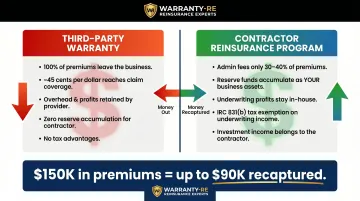
For a plumbing contractor generating $150,000 in warranty premiums annually, that structural shift can mean recapturing $60,000–$90,000 in profits that currently flow out the door.
How to Estimate the Right Budget—And What Most Contractors Miss
The right program investment is determined by business fit, not lowest price alone. WarrantyRE offers expert business analysis to help plumbing contractors model their specific program economics before committing.
Factors to consider when sizing your budget:
- Annual warranty sales volume and average contract value
- Current spend on third-party warranty providers (this is the baseline to beat)
- Projected claim frequency based on service quality and system type
- State regulatory requirements (Florida is strictest; states with limited regulation reduce compliance costs)
- Full-service versus partial administration needs
What most plumbing contractors miss:
Admin fees are only part of the picture. The reserve you build is your money, not an expense. Accumulate $200,000 in reserves over three years and pay out $80,000 in claims, and you've retained $120,000 inside your own business structure.
Your reserves can also generate investment income. According to standard captive insurance guidelines, once balance sheet cash exceeds 125% of unearned premiums, excess funds can be invested more aggressively. Even conservative government bonds produce returns, and that investment income belongs entirely to your reinsurance company.
Tax planning value is frequently overlooked. Under IRC Section 831(b), underwriting income is exempt from federal income tax, with tax applying only to investment income. For contractors writing large tax checks at year-end, contributions to the reinsurance account reduce taxable income while building business value.
Cost scales with volume — it isn't fixed. Higher warranty sales lower the effective cost per warranty. A contractor selling 50 warranties monthly spreads administrative costs across more premiums, reducing per-unit cost compared to someone selling 10 monthly.
Frequently Asked Questions
What is the average monthly cost of a home warranty policy?
Most consumer home warranty plans cost about $57 per month, or roughly $684 annually. However, this is a consumer-facing product distinct from a contractor-owned reinsurance program—the contractor's reinsurance structure collects those premiums on behalf of the contractor rather than paying them to a third party.
How much does plumbing liability insurance cost?
Plumbing contractors pay a median of $115 per month ($1,378 annually) for general liability insurance with typical limits of $1 million per occurrence / $2 million aggregate. Liability insurance is a separate product from warranty reinsurance—reinsurance addresses warranty claim risk, not liability exposure from accidents or property damage.
Does repiping lower insurance?
Repiping can reduce homeowner insurance premiums by lowering water damage risk, especially in homes built in the 1950s or earlier. For plumbing contractors offering warranties, higher-quality installs like repiping projects reduce warranty claim frequency, which improves the economics of a contractor-owned reinsurance program over time.
How is a plumbing warranty reinsurance program different from just buying a warranty plan from a third party?
With a third-party warranty, the contractor pays premiums to an outside company that keeps the profit. With a reinsurance program, the contractor owns the obligor structure, retains underwriting profits, and builds a reserve asset—transforming warranties from a cost into a revenue stream.
How long does it take to set up a plumbing warranty reinsurance program?
Setup timelines vary based on state requirements and program complexity. Captive feasibility studies typically take 4-8 weeks, with formation taking 2+ months, totaling approximately 3-4 months or longer. An experienced administrator speeds this up by handling entity formation, state filings, and compliance requirements directly.
What is the return on investment for a plumbing warranty reinsurance program?
ROI depends on warranty volume, claim rates, and program structure. If you sell $150,000 in annual warranties with a 40% claims rate, you retain $90,000 in underwriting profits and reserves instead of paying a third party. WarrantyRE's business analysis process helps contractors model expected returns—including tax advantages and investment income—before launching.