
This guide breaks down the best electrical warranty companies for contractors, the evaluation criteria used, and what to look for before signing up.
TL;DR
- Electrical contractors have three main options: third-party administrators, home warranty networks, or reinsurance models where they own the warranty company
- The best option depends on whether your priority is simplicity, claim speed, or long-term profit capture
- Red flags: vague coverage language, high denial rates, programs that keep all underwriting profits
- WarrantyRE helps electrical contractors own their warranty company and keep 100% of underwriting profits, rather than paying a third party
- A properly structured warranty program reduces callback costs, boosts retention, and generates recurring revenue
What Are Electrical Warranty Programs for Contractors?
An electrical warranty program is a service agreement covering repairs or replacements of electrical systems and components due to workmanship defects or component failure. It's a separate product from homeowners insurance or general liability — each covers a different risk:
- Homeowners insurance: fortuitous events like fire or theft
- General liability: bodily injury or property damage
- Electrical warranty: workmanship defects and component failures
Two Main Program Structures:
- Third-Party Administered: A warranty company handles all claims. The contractor earns a fee or gains brand credibility but keeps none of the underwriting profit.
- Contractor-Owned (Reinsurance Model): The contractor establishes their own warranty company, collects premiums, controls the claims process, and retains the underwriting profit directly.
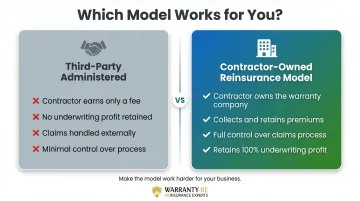
That distinction between program types matters for compliance, not just profitability. The NAIC Service Contracts Model Act #685, now adopted in 34+ states, defines service contracts as covering "repair, replacement, or maintenance of property" due to "operational or structural failure" — explicitly distinguishing them from insurance products.
Best Electrical Warranty Companies for Contractors
Companies were evaluated on coverage scope, claims process reliability, contractor profit potential, program compliance, and support infrastructure.
WarrantyRE
Founded in 1994 by Tim Byrd in Southeast Virginia, WarrantyRE has over 30 years of experience helping business owners establish and manage their own administrator obligor reinsurance companies. Originally serving automotive dealers, the company now provides reinsurance programs for home service contractors—including electrical, HVAC, roofing, and plumbing—across all 50 states.
Why It Stands Out for Electrical Contractors:
Instead of paying a third party, contractors build their own warranty company backed by A-rated insurers. Contractors keep 100% of underwriting profits, gain full claims control, and benefit from WarrantyRE's full-service administration—including training, compliance, bookkeeping, tax returns, and performance reporting.
Warranty fees collected on every job flow into the contractor's own tax-advantaged reinsurance account. When claims arise, they're covered from this pool. Unused funds remain with the contractor, turning installations into recurring revenue.
| Program Type | Administrator Obligor Reinsurance — contractor owns the warranty company |
|---|---|
| Coverage Scope | Customizable to electrical system warranties, installations, and components; tailored to contractor's service offerings |
| Contractor Benefit | Full profit capture, tax planning advantages under IRS Code 831(b), recurring revenue, dedicated onboarding/support team |
Warrantech (Amynta Group)
Founded in 1983, Warrantech operates as a service contract administrator under the Amynta Group umbrella. The company focuses primarily on automotive vehicle service contracts; its parent company covers consumer appliances and systems.
Key Differentiators:
Established claims infrastructure, regulatory compliance support across multiple states, and white-label service agreement capability for dealers and contractors. However, Warrantech's brand positioning centers on automotive F&I products rather than home service contractors.
| Program Type | Third-party service contract administrator |
|---|---|
| Coverage Scope | Primarily automotive-focused; broader Amynta Group covers consumer appliances and systems |
| Contractor Benefit | Full-service compliance and claims handling; revenue-share structure not publicly disclosed |
Note: Warrantech does not currently offer programs designed specifically for independent electrical contractors.
EFG Companies
Founded in 1977 by Oklahoma businessman Bob Moore, EFG Companies has nearly 50 years of experience serving over 1,000 clients across North America. Originally an automotive F&I administrator, EFG has since expanded into the home warranty space.
Why It's Relevant for Electrical Contractors:
EFG offers Home Protection Products that specifically include electrical system coverage. Their program is positioned B2B2C—home service providers and contractors sell EFG warranties directly to customers.
Key Features:
- Coverage for appliances and systems including electrical systems, heating, cooling, plumbing, and water heaters
- Pre-existing condition coverage
- 21-Day Payment Guarantee for contractors
- Reinsurance profit participation options backed by A.M. Best A-rated insurers
Reinsurance Programs Available:
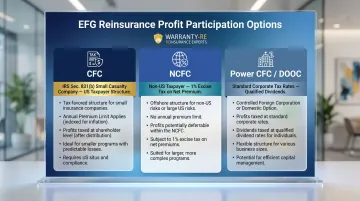
EFG offers three profit participation structures that determine how contractors receive earnings from their warranty programs:
- Controlled Foreign Corporation (CFC) — IRS Sec 831(b) small casualty company structure
- Non-Controlled Foreign Corporation (NCFC) — non-US taxpayer; 1% excise tax on net premium
- Power CFC & Dealer-Owned Obligor Company (DOOC) — standard corporate tax rates with qualified dividends
| Program Type | Service contract administrator with contractor profit participation options |
|---|---|
| Coverage Scope | Electrical systems, appliances, HVAC, plumbing; includes pre-existing conditions |
| Contractor Benefit | Profit participation structures (CFC, NCFC, DOOC), 21-Day Payment Guarantee, backed by A-rated insurers |
American Home Shield (Contractor Network)
Founded in 1971 and credited with inventing the home warranty industry, American Home Shield (AHS) is a subsidiary of Frontdoor, Inc. (NASDAQ: FTDR). According to Frontdoor's FY2025 financial results, AHS serves 2.11 million home warranty members. The company operates a network of approximately 17,000 independent service contractors across 48 states.
How It Works for Electrical Contractors:
AHS contracts with licensed electrical contractors to fulfill warranty service requests from its member base. Contractors gain dispatched work volume but do not own the warranty or capture underwriting profits. This model suits contractors looking to supplement revenue with steady service calls rather than build their own warranty business.
Network Details:
- Approximately 3.8 million service requests handled annually
- Contractors vetted for licensing and performance standards
- Fixed service fees of $100 or $125 per claim (paid by homeowner)
- 30-day workmanship guarantee on repairs
- Streem AR/AI-powered video chat for remote diagnostics
| Program Type | Home warranty network partnership — contractor fulfills claims on behalf of AHS |
|---|---|
| Coverage Scope | Electrical system repairs dispatched by AHS; up to 29 home systems and appliances covered |
| Contractor Benefit | Steady dispatched work volume, no warranty sales required; contractor pay rates not publicly disclosed |
Important Note: The "2+ million" figure represents plan members (homeowners), not contractors. AHS contractor pay rates beyond consumer-facing service fees are not publicly disclosed.
Centricity
Formed in 2017 via the merger of Bankers Warranty Group and Bonded Builders Warranty Group under parent company Bankers Financial Corporation (founded 1976), Centricity has 48 years of combined corporate history.
Current Focus:
In 2021, Centricity spun off its home warranty business into a separate company called Maverick Builders. Centricity now operates as a lifestyle services company focusing on product protection for retail categories:
- Flooring, cabinets, countertops
- Jewelry
- Electronics
Centricity uses the ServicePower platform for dispatches, authorizations, and claims, with payments processed on a weekly cycle.
| Program Type | Third-party product protection administrator (no longer home warranty focused) |
|---|---|
| Coverage Scope | Flooring, cabinets, countertops, jewelry, electronics—not electrical contractor services |
| Contractor Benefit | Not applicable for electrical contractors; home warranty business spun off in 2021 |
Note: Centricity does not currently offer service contract programs designed for independent electrical contractors.
How We Chose the Best Electrical Warranty Companies
Programs were assessed on their ability to deliver real business value—not just coverage breadth, but contractor profit potential, compliance support, claims reliability, and ease of administration. The most common mistake contractors make is choosing based solely on brand name or low price without understanding who keeps the underwriting profit.
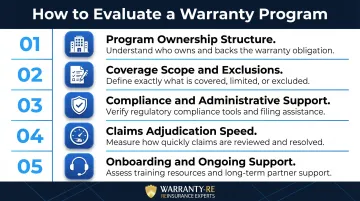
Key Evaluation Factors:
- Program ownership structure — Does the contractor share in underwriting profits or pay fees only?
- Coverage scope and exclusions relevant to electrical work
- Compliance and administrative support across states
- Claims adjudication speed and contractor control
- Quality of onboarding and ongoing support
Contractor-owned reinsurance programs offer the highest profit ceiling—but they only deliver that upside when the administrator behind them handles compliance, claims, and reporting without gaps. That operational execution is what separates programs worth owning from ones that quietly drain time and margin.
Conclusion
The best electrical warranty company for a contractor fits how they actually run and grow their business. If the goal is simply to add a warranty offering with minimal overhead, a third-party administrator may suffice. If the goal is to build a more profitable, loyalty-driving business, owning the warranty program delivers far greater long-term value.
Before signing any warranty program agreement, evaluate:
- Profit potential — what share of underwriting income do you keep?
- Administrative burden — who handles claims, compliance, and filings?
- Claims transparency — do you have visibility into what's being paid and why?
- Compliance support — are state filings and renewals managed for you?
A low-cost entry point that locks underwriting profits with a third party can cost more than it saves.
If owning your warranty program is the direction that makes sense, WarrantyRE is worth a conversation.
Ready to explore owning your own electrical warranty company?
Reach out to WarrantyRE at (804) 824-9533 or visit their website. Since 1994, they've helped contractors establish captive warranty structures — handling claims administration, compliance, and reinsurance setup — so the underwriting profits stay with your business.
Frequently Asked Questions
Who is the best warranty provider for electrical contractors?
The best provider depends on your business model. Contractors who want turnkey simplicity may prefer a third-party administrator like EFG Companies. Contractors focused on profitability and long-term growth often benefit most from owning their own warranty company through a reinsurance program like WarrantyRE.
What is a red flag on a warranty program for contractors?
Watch for vague exclusion language that makes claims easy to deny, no transparency into profit allocation, high monthly fees with no profit participation, and no dedicated compliance support. Any program that keeps all underwriting profits in-house costs contractors thousands annually.
What is the role of a warranty administrator?
A warranty administrator handles the operational side of a warranty program: claims adjudication, compliance filings, customer communication, and bookkeeping. In a contractor-owned reinsurance model, the administrator works on behalf of the contractor's own warranty company rather than a third party.
Can electrical contractors offer their own warranty programs to customers?
Yes. Through a contractor-owned reinsurance structure (the administrator obligor model), electrical contractors can establish their own warranty companies, sell service contracts to customers, and keep the underwriting profit rather than paying those margins to a third-party provider.
How does a warranty program generate recurring revenue for electrical contractors?
When contractors sell service agreements to customers, the premiums collected fund the warranty reserve. In a reinsurance model, unused claims reserves and underwriting profits flow back to the contractor's company. Every installation becomes a source of long-term recurring income.
What electrical work is typically covered under contractor warranty programs?
Coverage varies by program but typically includes workmanship defects, panel and wiring repairs, and component failures on installed systems. Labor on service upgrades, panel replacements, and grounding systems may also qualify. Always verify exclusions before enrolling, as equipment warranties from manufacturers like Square D or Siemens are handled separately.