This article isn't about general liability insurance. It's specifically about the coverage structure behind the warranties contractors are already promising customers, and whether reinsurance is something they genuinely need.
TL;DR
- Every warranty claim without reinsurance backing comes directly out of operating cash
- Self-funded warranties carry no reserve, no protection, and no upside when claims stay low
- The admin-obligor model limits downside risk while capturing the underwriting profit third-party providers currently keep
- Eligibility thresholds are lower than most contractors assume — a free business analysis confirms whether you qualify
- The 831(b) tax election (up to $2.9M in annual net premiums) makes a properly structured program a legitimate tax planning tool
What Is Warranty Reinsurance Coverage for Contractors?
Warranty reinsurance is a structure in which an A-rated insurance carrier provides the financial guarantee behind the warranties a contractor sells. If total claims exceed the contractor's reserves, the reinsurer absorbs the excess loss.
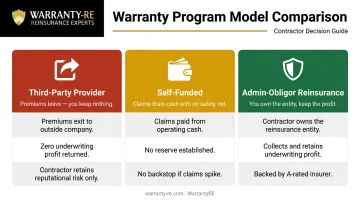
Most contractors operate under one of three structures:
- Third-party provider model — Premiums go to an outside warranty company. That company manages claims, keeps all underwriting profit, and returns nothing to the contractor regardless of claim volume.
- Self-funded model — The contractor pays warranty claims out of operating cash with no reserve, no backstop, and no structure around the obligation at all.
- Admin-obligor reinsurance model — The contractor owns a separate warranty entity backed by an A-rated insurer. That entity collects premiums, manages a reserve, and retains any underwriting profit after claims are paid.
Warranty reinsurance is not the same as general liability or errors and omissions coverage. Both of those cover damage and mistakes — neither covers the contractor's obligation to honor a warranty they've already promised a customer.
What "Administrator-Obligor" Actually Means
In the admin-obligor structure, the contractor's entity plays two roles at once:
- Administrator — manages the program, collects premiums, oversees claims
- Obligor — is legally responsible for honoring warranty claims
The A-rated reinsurer stands behind that obligation as a financial backstop — if the contractor's entity cannot meet its obligations, the reinsurer steps in. That carrier backing is what makes contractor-owned programs legally viable in regulated states. Without it, most states require contractors to either maintain large reserve funds or register as insurance entities outright.
In the third-party model, none of that structure exists on the contractor's side. The premium leaves, the profit leaves with it, and the contractor carries the reputational exposure either way.
The Real Risks Contractors Face Without Reinsurance Backing
Financial Exposure from Self-Funding
When a contractor self-funds warranties without any reinsurance structure, every claim comes directly from operating cash. There's no reserve and no backstop. One bad installation year — clustering equipment failures, a subcontractor error pattern, or a high-volume callback period — can cost far more than anticipated.
An ACCA analysis of a $2M HVAC contractor estimated callback costs of roughly $80,000 annually at a 5% callback rate, accounting for technician time, overhead, and lost revenue from missed paid work. That number doesn't include the compounding effect of multi-year warranty obligations.
The Long-Tail Problem
Multi-year labor warranties and extended service agreements create deferred liabilities. A contractor who installs 200 HVAC systems this year and offers a five-year labor warranty doesn't receive the claim this year; they receive it in year three or four, when the business may be in a completely different financial position. The obligation is long-dated; the cash to cover it is not set aside anywhere structured.
Regulatory Exposure
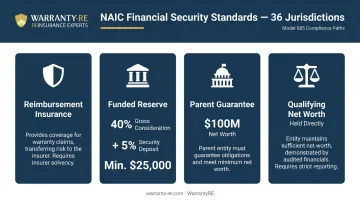
The NAIC Service Contracts Model Act (Model 685) now covers 36 jurisdictions including DC. It requires service contract providers to meet one of four financial security standards:
- Reimbursement insurance from a qualified carrier
- A funded reserve of at least 40% of gross consideration received, plus a security deposit of at least 5% (minimum $25,000)
- A parent guarantee backed by $100M in net worth
- Qualifying net worth held directly by the provider
Washington State can fine providers up to $2,000 per violation. Texas, New York, Nevada, and South Carolina each have their own registration and financial security frameworks. A contractor who is technically selling a "service contract" without meeting these requirements may be operating outside the law without realizing it.
The Hidden Cost Contractors Routinely Undercount
That regulatory exposure compounds an internal blind spot. Most contractors don't categorize callback warranty work as a warranty claim — it gets absorbed into labor costs, vehicle expenses, or overhead, leaving no clear picture of actual annual warranty exposure.
Start by pulling the last 12 months of warranty-related costs:
- Callback labor and technician time
- Fuel and vehicle costs for unpaid return visits
- Parts used on warranty calls
- Revenue lost by sending a tech to a warranty job instead of a paid one
For most contractors, that total is larger than expected. And none of it has a reserve behind it.
What Warranty Reinsurance Covers — and What It Doesn't
What Reinsurance Is Designed to Back
Reinsurance programs for contractors typically cover:
- Labor-only workmanship warranties — the most common structure; covers the contractor's installation labor when a defect emerges
- Extended service agreements — multi-year coverage on installed equipment, often sold as an add-on at the time of installation
- Parts-and-labor warranties — combined coverage, which carries a higher risk profile and requires different reserve modeling
Labor-only programs tend to have lower and more predictable claim rates. Extended service agreements have longer tails and require more careful reserve calculations.
Common Exclusions
Standard exclusions in service contract programs typically include:
- Storm or lightning damage
- Pre-existing conditions
- Customer misuse
- Failures caused by a party other than the insured contractor
These align with NAIC Model 685 disclosure requirements, which mandate that contracts clearly state whether consequential damages or pre-existing conditions are excluded.
Monitoring Program Health with Loss Ratios
A loss ratio measures claims paid divided by earned premiums. A 100% loss ratio means break-even — no profit, no loss. Well-managed programs target ratios below that threshold, with the gap representing underwriting profit retained by the contractor's entity.
The Casualty Actuarial Society notes that calendar-year loss ratios can be misleading in service contract programs because premium earning patterns and claim emergence don't always align. Program-specific actuarial support is more reliable than industry-wide benchmarks.
Which Contractors Actually Need Warranty Reinsurance
Signs You May Not Need a Formal Program Yet
- Minimal warranty volume relative to program setup costs
- Exclusively short-term, low-dollar obligations with no multi-year exposure
- Early-stage business where premium inflow doesn't yet justify a separate entity
Signs You've Crossed the Threshold
- Completing a meaningful number of warranty-eligible jobs annually with labor warranties included as standard
- Average ticket size large enough to support a warranty premium in your pricing
- Already offering multi-year extended service agreements — especially on HVAC, roofing, or major mechanical installs
If your business checks any of those boxes, the "I'll just pay claims as they come" approach carries real risk. The liability is deferred, not eliminated. A contractor who issued 150 five-year labor warranties three years ago has warranty obligations coming due right now.
One common misconception is that reinsurance is only for high-volume operations. After 30 years working with HVAC, roofing, plumbing, and electrical contractors, WarrantyRE has found that the biggest barrier is awareness, not size. Many smaller contractors simply haven't been approached about the option. A free business analysis is the clearest way to determine whether a program makes sense.
How the Admin-Obligor Model Turns Reinsurance Into a Profit Center
From Cost Center to Revenue Asset
In a third-party warranty program, the contractor sells the warranty, the customer pays the premium, and the third party keeps the underwriting profit. In a down-claim year — when your installs hold and callbacks are minimal — the outside provider keeps everything.
In the admin-obligor model, the contractor's own entity collects those premiums, funds a reserve, and retains what's left after claims are paid. The premium revenue doesn't leave. The profit stays.
Investment Income on Reserves
Premium reserves held between collection and claims payout don't sit idle. In WarrantyRE's structure, reserve funds are held in a US-based trust account and invested in government bonds. Investment income earned on reserves belongs to the reinsurance company owner.
A few figures worth knowing:
- U.S. property/casualty insurers earned $89 billion in investment income in 2024
- Bond portfolio yields reached 4.1% — the secondary return available on reserve assets even in conservative allocations
- Once reserve balances exceed 125% of unearned premiums, excess funds may be invested more aggressively at the direction of company ownership
The 831(b) Tax Advantage
Property and casualty insurance companies with annual net written premiums under $2,900,000 (the 2026 IRS threshold per Rev. Proc. 2025-32) may elect under IRS Code 831(b) to be taxed only on investment income — not on underwriting profit. This is a statutory election available to qualifying small non-life insurers — not a gray area.
WarrantyRE structures programs to comply fully with IRS standards. The reinsurance company files Form 1120PC annually, with returns prepared by insurance tax specialists. The IRS no longer lists properly organized reinsurance companies in listed transactions — reviewed programs were confirmed compliant.
A Separate Financial Asset — and a Long-Term Business Build
The contractor's reinsurance company is a legally distinct entity. It accumulates value over time, maintains its own financials, and operates independently of the contracting business.
That distinction matters beyond annual tax savings. A reinsurance company with a growing reserve balance, a clean claims history, and documented financials is a transferable asset — something that can be sold, passed to a successor, or used to demonstrate enterprise value. A third-party warranty arrangement creates none of that. The premium leaves, the profit follows, and the contractor has nothing to show for years of low-claim performance.
For contractors thinking beyond the next fiscal year, the reinsurance company itself becomes part of the exit or succession story.
What WarrantyRE Handles
The administrative burden on the contractor is minimal from day one. WarrantyRE manages:
- Legal entity formation and state filings
- Claims adjudication from first call to final resolution
- Compliance management across applicable state frameworks
- Monthly financial statements and performance reports
- Annual tax returns (Form 1120PC) prepared by insurance tax specialists
- All renewals and ongoing regulatory requirements
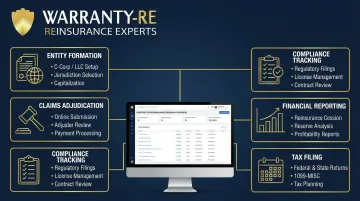
The contractor focuses on running the contracting business. The reinsurance structure — and the profit it generates — runs in the background.
Frequently Asked Questions
Do contractors provide a warranty?
Most contractors offer some form of workmanship or labor warranty, though terms, duration, and financial backing vary widely. Contractors who offer warranties without reinsurance backing take on the full financial obligation personally — every claim comes out of operating cash with no reserve behind it.
What insurance should an independent contractor have?
General liability, workers' compensation, and professional liability each cover distinct risks — accidental damage, employee injuries, and professional errors, respectively. None of them cover a contractor's obligation to honor a warranty contract. That requires a separate reinsurance structure.
Is warranty reinsurance the same as contractor liability insurance?
No. Liability insurance covers damage to third parties or professional errors. Warranty reinsurance backs the contractor's obligation to honor warranty claims when covered work fails. They address different obligations, and contractors offering customer warranties need both.
What happens if a contractor offers warranties without proper backing?
Three risks emerge: financial exposure when claims exceed available cash flow, regulatory penalties in states requiring service contract financial security (fines can reach $2,000 per violation in states like Washington), and reputational damage when a warranty claim cannot be honored. Each risk compounds the others.
How much warranty volume does a contractor need to qualify for reinsurance?
Volume thresholds are lower than most contractors expect. WarrantyRE works with contractors across HVAC, roofing, plumbing, and electrical trades at various sizes — most who qualify simply haven't looked into it yet. A free business analysis is the starting point for any contractor evaluating eligibility.