
Introduction
Most home service contractors — HVAC technicians, roofers, plumbers, and electricians — are quietly handing underwriting profits to third-party warranty providers every time they sell a labor warranty or service agreement. By establishing their own reinsurance company, contractors can recapture those profits, turning warranty obligations from a cost center into a controlled, recurring revenue stream.
The biggest barrier is a knowledge gap: most contractors assume setting up their own reinsurance program costs as much as traditional captive insurance formation, which can require $50,000–$100,000 in fees and $250,000 in minimum capitalization. Contractor-focused administrator obligor programs work differently — and cost significantly less.
This guide breaks down realistic startup cost ranges for contractor-focused reinsurance programs, the components that drive total investment, what influences costs up or down, and how to evaluate whether the numbers work for your business.
TL;DR
- Startup costs are far lower than traditional captive insurance — offshore domiciles like Turks and Caicos require as little as $5,000 in paid-up capital vs. $250,000+ for domestic captives
- Biggest cost drivers: formation fees, initial capital deposit, ceding fees (6-10% of premiums), state premium taxes (1.6-2.35%), and annual administration
- Upfront investment scales with contractor size — larger warranty volume means proportionally greater underwriting profits captured
- The right program pays for itself — contractors already fund warranty programs; they're just funding someone else's profits
- Initial capital sits in trust and can be invested, generating ROI on top of underwriting profits — not a sunk cost
How Much Does It Cost to Start a Reinsurance Company as a Home Service Contractor?
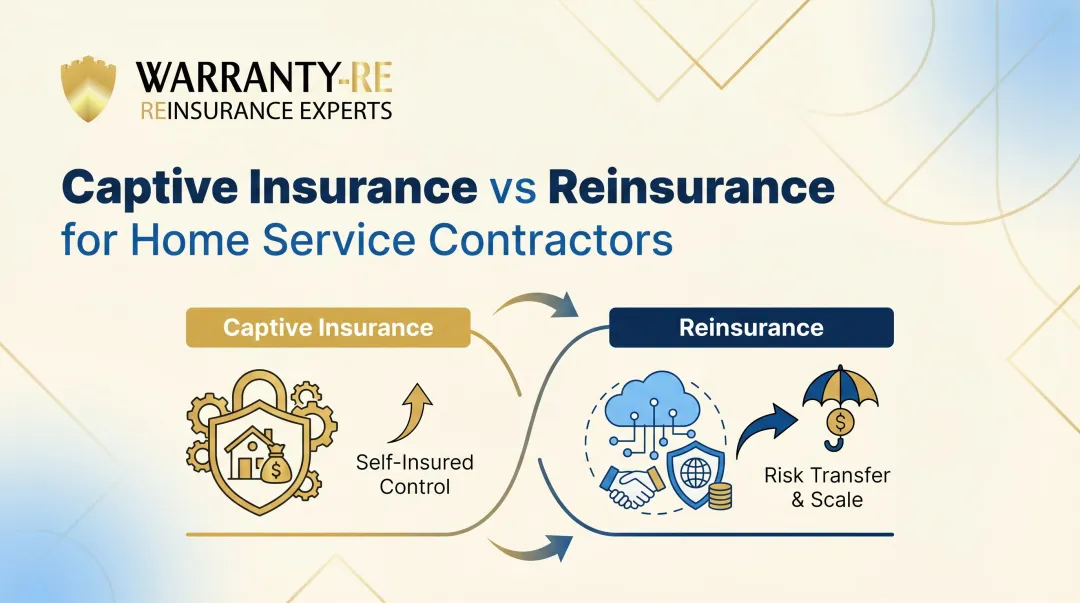
Contractor reinsurance programs operate under a fundamentally different cost structure than traditional captive insurance companies. While traditional captives require $50,000–$100,000 in formation fees and $250,000 minimum capitalization, contractor-focused administrator obligor programs are designed to be significantly more accessible — often at a fraction of that entry cost. Here's how startup costs break down across three program tiers.
Tier 1: Entry-Level / Small Contractor Program
Small contractor programs prioritize accessibility without compromising compliance. Formation typically includes:
- Corporate entity formation in offshore domicile (commonly Turks and Caicos)
- Reinsurance license application and approval
- Corporate documents, bylaws, and stock certificates
- Tax ID (EIN) registration
- IRS election filings (953(d) for domestic tax treatment, 831(b) for small company tax benefits)
The Turks and Caicos Islands Financial Services Commission recommends only $5,000 minimum paid-up capital for Producer Affiliated Reinsurance Companies (PARCs), versus $100,000+ for general captives. Combined with formation and legal fees, total startup investment for Tier 1 programs typically runs $10,000–$20,000.
Best for: Contractors just launching a warranty program or those with modest annual warranty volume who want to test the model before scaling.
Tier 2: Mid-Range / Established Contractor Program
Mid-tier setups include formation plus a more substantial initial trust deposit, first-year administration, and comprehensive compliance support. These programs accommodate contractors with consistent warranty sales who are ready to capture ongoing underwriting profits.
Typical components:
- All Tier 1 formation services
- Initial capital deposit of $15,000–$30,000
- First-year administration fees (claims, compliance, financial reporting)
- Custodial trust account setup
Total investment typically ranges $25,000–$50,000 depending on warranty volume.
Best for: Contractors with a consistent customer base selling warranties on HVAC systems, roofing installations, plumbing work, or electrical projects.
Tier 3: Full-Service / High-Volume Program
Full-service programs include hands-on account management, substantial trust accounts, active investment management, and complete annual administration — covering tax returns, claims adjudication, compliance filings, and performance reporting.
Key features:
- Higher initial capital deposits ($50,000+)
- Advanced investment strategies once reserves exceed 125% of unearned premiums
- Monthly performance reporting and owner advisory meetings
- Full claims administration and regulatory coordination
Total investment typically starts at $50,000–$75,000 and scales with premium volume.
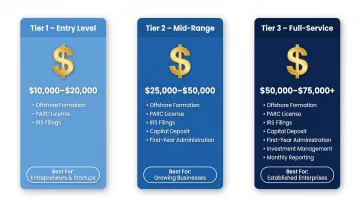
Best for: Large contractors or multi-location operations ready to fully optimize warranty profits and hand off compliance management.
What Are the Core Startup Cost Components?
Startup costs fall into two categories: one-time formation expenses and recurring annual costs. Understanding both upfront prevents budget surprises down the road.
Formation and Legal Fees
Company formation involves attorney fees to create the corporate entity, obtain the reinsurance license, prepare corporate documents and stock certificates, secure a Tax ID, and complete required IRS filings.
Typical formation fees include:
- Corporate entity registration
- License application preparation and filing
- Corporate documents (articles, bylaws, operating agreements)
- Registered agent appointment
- Tax ID (EIN) registration
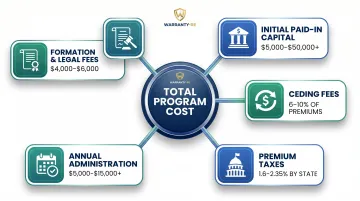
While historical benchmarks place formation fees around $4,000–$6,000, contractors should verify current market rates with their formation partner.
Initial Paid-In Capital
The IRS requires reinsurance companies to be capitalized with a reasonable initial deposit to be treated as legitimate insurance entities. This capital should reflect the level of starting risk being assumed.
Critical distinction: Initial capital is not a sunk cost. These funds sit in a trust account, can be invested, and generate additional ROI. The Turks and Caicos minimum of $5,000 sets the regulatory floor — most contractors capitalize between $10,000 and $50,000 based on program size and starting risk volume.
Ceding Fees
Ceding fees are the percentage charged by the admitted carrier that transfers (cedes) risk and premium reserves to the contractor's reinsurance company. According to Captive.com, fronting fees typically range from 6% to 10% of gross written premiums, depending on the scope of services provided.
Some providers bundle ceding fees into administration fees, so contractors should clarify this structure upfront.
Premium Taxes and Custodial Fees
Premium taxes are assessed by the state where the admitted carrier files. Most states impose premium taxes ranging from 1% to 3% of direct premiums written. Two common examples:
- Texas: 1.6% on property/casualty premiums
- California: 2.35% on property/casualty premiums
Custodial fees are charged by the money manager overseeing the trust account. Typical asset-based custodial pricing ranges from 10 to 15 basis points (0.10%–0.15%) of assets under management.
Annual Ongoing Administration Costs
Recurring costs include:
- Annual renewal fees
- Accounting records and monthly financial statements
- Tax return preparation (Form 1120-PC)
- CPA and attorney filings
- Compliance monitoring and regulatory submissions
Full-service reinsurance partners typically manage all of these tasks. Annual administration costs vary by program size but generally range $5,000–$15,000+ depending on warranty volume and service scope.
Key Factors That Affect Your Total Startup Cost
The total cost of a contractor reinsurance program is not fixed. It scales with warranty volume, service scope, domicile selection, and whether the contractor uses a full-service management partner or builds out administration independently.
Warranty Volume and Premium Flow
The more warranties a contractor sells, the larger the premium reserves flowing into the reinsurance company. This increases the base on which ceding fees, premium taxes, and custodial fees are calculated — but also increases investment and profit potential.
A contractor selling a handful of HVAC service agreements has very different economics than one closing 200+ jobs per year. Higher volume justifies higher initial capital investment because profit capture scales proportionally — making the case for full program administration stronger as the business grows.
Domicile Selection
The choice of reinsurance company domicile affects licensing fees, regulatory requirements, and ongoing compliance costs. Offshore domiciles like Turks and Caicos offer substantially lower capital requirements than domestic states.
Red flags to watch for:
- Promoters recommending domiciles with minimal regulatory oversight
- Structures that fail to meet IRS Notice 2016-66 standards (e.g., premiums significantly exceeding commercial rates, inadequate capitalization, or liabilities for losses under 70% of earned premiums over five years)
- Arrangements that invest reinsurance capital in illiquid or speculative assets
IRS enforcement has intensified, with penalties levied against micro-captive promoters in 2025. Proper structuring and actuarial support are essential.
Level of Administration and Management Support
Self-administered programs carry lower fees but a heavier internal burden. Contractors must handle claims adjudication, compliance filings, financial reporting, and tax preparation independently — or source and manage each vendor separately.
Fully managed programs cost more upfront but reduce that operational risk considerably. A full-service partner handles all administration, freeing contractors from back-office complexity while the reinsurance profits flow through.
Claims History and Risk Profile
Administration decisions affect cost structure — but claims history shapes the long-term economics of the entire program. Contractors with strong track records of low warranty claims — well-installed HVAC systems, quality roofing, minimal callbacks — face lower reserve requirements and more favorable ceding terms. Quality workmanship isn't just a service standard; it's a direct profitability driver inside the reinsurance model.
Minimal Setup vs. Full-Service Program: What's the Difference?
Contractors evaluating reinsurance programs often face a choice between lower-cost bare-bones formation and a full-service managed model. The differences go well beyond price.
| Component | Minimal Setup | Full-Service Program |
|---|---|---|
| Formation | Corporate documents, EIN, basic license | Complete formation + compliance coordination |
| Compliance Management | Contractor handles filings independently | Partner manages all legal forms, filings, renewals |
| Claims Administration | Contractor or hired vendor | Full claims adjudication from first call to final resolution |
| Tax Preparation | Contractor hires separate CPA | Tax returns prepared by insurance tax experts |
| Financial Reporting | Contractor maintains records | Monthly statements, annual reports, performance analysis |
| Long-Term Risk | High audit risk if non-compliant | Reduced risk through expert oversight |
| Best For | Experienced insurance professionals | Contractors focused on their trade, not insurance administration |
A minimal setup may look cheaper on paper, but for contractors without insurance industry experience, the compliance risk, administrative burden, and missed optimization opportunities can quickly outweigh any upfront savings.
How to Budget for Your Reinsurance Company — and What Most Contractors Get Wrong
Building an accurate budget requires looking beyond the formation invoice and accounting for the full lifecycle of the program.
Budgeting Checklist
- Projected annual warranty sales volume — estimate jobs sold with warranties
- Expected premium flow — calculate total warranty fees collected
- Estimated claims reserve — project claims payout as percentage of premiums
- Formation and legal fees — one-time startup costs
- Initial capital deposit — trust account funding
- First-year administration — claims, compliance, financial reporting
- Ongoing recurring costs — annual renewal, tax preparation, custodial fees
- State premium taxes — calculate based on your primary service states
- Ceding fees — apply 6-10% to projected premium flow
Once you've mapped out these line items, the checklist makes one thing obvious: several recurring costs catch contractors off guard. Here's where most budgets break down.
The Most Common Budgeting Mistakes
Mistake #1: Budgeting only for the formation invoice.
Ongoing fees — custodial charges, premium taxes, annual renewals — don't show up on the initial quote. Plan for the full annual cycle from day one, not just what it costs to get started.
Mistake #2: Writing off the initial capital deposit.
Initial capital isn't a cost — it's an asset sitting in a trust account that can be invested. Once your balance sheet cash exceeds 125% of unearned premiums, those excess funds can move into higher-yield instruments, generating additional ROI on top of your underwriting profits.
The Profitability Angle
The real budget question is what you're currently spending on third-party warranty providers. For most contractors, the reinsurance program pays for itself within 1–2 years by capturing profits that were flowing out of the business.
Consider an HVAC contractor selling $200,000 in annual warranty premiums to a third-party provider. When claims stay low, the underwriting profit disappears into someone else's balance sheet. By owning their reinsurance company, that contractor keeps 100% of those profits. After deducting ceding fees, administration, and premium taxes, the net gain typically exceeds total setup and first-year costs within 12–24 months.

Frequently Asked Questions
How much money would I need to start a reinsurance company?
Contractor-focused reinsurance programs are significantly cheaper than traditional insurance company startups. While traditional captives require $50,000–$100,000 in formation fees and $250,000 minimum capitalization, contractor programs typically cost $10,000–$75,000 depending on program size, covering formation fees, initial capital, and first-year administration.
What are common startup costs for a reinsurance company?
Main categories include legal and formation fees ($4,000–$6,000), initial paid-in capital ($5,000–$50,000+), ceding fees (6-10% of premiums), state premium taxes (1.6-2.35%), custodial fees (10-15 basis points on trust assets), and annual administration and tax preparation costs ($5,000–$15,000+).
Are reinsurance companies profitable?
Contractor reinsurance programs are profitable for owners who maintain consistent warranty volume and manage claims well. The contractor captures underwriting profits previously paid to third-party providers, and trust funds can be invested for additional returns. Contractors with steady sales and low claims typically recover their startup costs within the first year.
What is the difference between a captive insurance company and a contractor reinsurance program?
Traditional captive insurance places full regulatory and financial liability on the business owner, requiring complex licensing and large capital reserves. The administrator obligor model is different: an A-rated admitted carrier backs the program and retains ultimate liability for claims, making it far more accessible for contractors who want the profit benefits of a captive without the regulatory burden.
How long does it take to set up a contractor reinsurance company?
General captive insurance formations typically take around 90 days, though full-service reinsurance partners can often complete setup faster when documentation is submitted early. Some offshore structures move more quickly than domestic formations depending on the chosen domicile.
How much does liability insurance cost for a reinsurance company?
In the administrator obligor model, contractors do not purchase separate liability insurance for the reinsurance company. An A-rated admitted carrier backs the program and retains ultimate liability for claim payments, limiting the contractor's financial exposure to formation costs and accumulated earnings.