But not all extended labor warranty programs are structured the same way. For homeowners, the difference shows up in what gets covered and what doesn't. For HVAC contractors, the difference shows up in the bottom line — specifically, who keeps the underwriting profit when claims come in below the premiums collected.
This article covers both sides of that equation: what extended labor warranties are, how they work mechanically, what's excluded, and — for contractors evaluating whether to offer them — how the program structure determines whether warranties are a cost or a revenue engine.
TL;DR
- Extended labor warranties cover technician labor costs when major HVAC components fail; manufacturer parts warranties never include this
- Coverage runs from 1 to 10 years, with 10-year plans matching manufacturer parts warranties for full protection
- For homeowners, these warranties convert unpredictable repair bills into financial certainty; for contractors, they create differentiation and recurring revenue
- Most contractors using third-party programs hand the underwriting profit (premiums minus claims) directly to the provider
- Contractors who own their reinsurance structure keep those profits — WarrantyRE handles setup, compliance, and administration
Equipment Warranty vs. Extended Labor Warranty: Key Differences
What Manufacturer Warranties Actually Cover
Major HVAC brands follow a consistent pattern. Without registration, most brands default to a 5-year parts-only limited warranty. Register the equipment within the required window — typically 60 to 90 days — and that extends to a 10-year parts warranty for most residential equipment.
| Brand | Unregistered | Registered | Registration Window |
|---|---|---|---|
| Carrier | 5-year parts | 10-year parts | 90 days |
| Trane | Base limited warranty | 10-year parts | 60 days |
| Goodman | 5-year parts | 10-year parts | 60 days |
| Lennox (Merit/Elite) | 5-year parts | 10-year parts | 60 days |
| York | Reduced term | 10-year parts | 90 days |
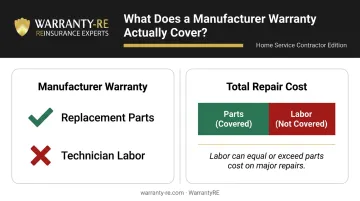
The critical word here is parts. According to Angi's 2026 HVAC repair cost guide, labor can account for as much as 50% of total repair costs — and manufacturer warranties cover none of it.
Registration deadlines are also routinely missed. A homeowner who installs a new system in October and skips the paperwork loses the full 10-year coverage — permanently. Contractors who make registration part of their installation checklist protect their customers and avoid post-repair disputes over coverage eligibility.
The Installer's Labor Warranty vs. an Extended Labor Warranty
Manufacturer warranties address parts — but they say nothing about the cost of the technician showing up. That's where the contractor's own labor warranty comes in. Most HVAC contractors cover their installation workmanship for the first one to two years. That protection applies to their workmanship, not component failures from normal wear and tear down the road.
An Extended Service Agreement (ESA) is a separate product that picks up when the installer's coverage runs out. It covers technician time when a covered component fails during normal operation. Key distinctions worth knowing:
- Covers labor costs for covered repairs — not parts (those fall under the manufacturer warranty)
- Runs concurrently with or after the installer's workmanship period
- Must be sold at installation — customers who call for service after a breakdown typically can't purchase one retroactively
That point-of-sale window is significant. Contractors who present ESAs at the time of install convert a single transaction into ongoing customer protection — and a recurring revenue stream.
How HVAC Extended Labor Warranties Work
The Mechanics of a Claim
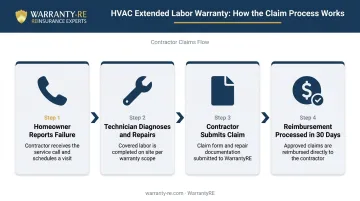
When a covered component fails, the process follows a predictable four-step path:
- Homeowner contacts the contractor to report the failure
- Technician diagnoses and completes the repair per covered categories
- Contractor submits a claim to the warranty administrator with supporting documentation
- Reimbursement is processed — typically within 30 days — based on the program's schedule
The homeowner pays no additional labor charge for covered repairs. That's the core value proposition — and why contractors who present it clearly tend to close more service agreements.
What's Typically Covered
Coverage lists vary by provider and plan tier, but most ESAs include repairs to these components when they fail under normal operating conditions:
- Compressor and filter drier
- Condenser coil and evaporator coil
- Heat exchanger
- Blower motor and fan motors
- Control board and capacitors
- Gas valve and reversing valve
- Thermostat
Contractors should review any program's specific covered component list before committing — coverage depth varies more than providers often advertise.
Exclusions to Know Upfront
JB Warranties' 2024 sample Extended Service Contract lists common exclusions that most programs share:
- Installation defects — ESAs cover component failures, not workmanship errors
- Acts of nature — flood, lightning, hurricane damage
- Cosmetic damage and rust
- Animal infestation
- Refrigerant disposal fees
- Failures tied to lack of required maintenance
The maintenance exclusion deserves special attention. The same JB Warranties agreement states that failure to maintain the product per manufacturer instructions may result in denial of coverage. Contractors who don't communicate this clearly at the point of sale set themselves up for disputes later.
Coverage Periods
Once you understand what's covered and what isn't, the next question is duration. Plans typically run 1, 2, 3, 5, or 10 years. The 10-year option is the most strategically valuable for new installations — it mirrors the manufacturer's registered parts warranty, giving homeowners complete parts-and-labor protection within the same window.
Benefits of Offering Extended Labor Warranties as an HVAC Contractor
The Numbers That Close Jobs
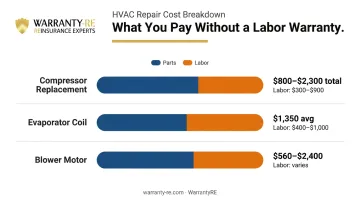
Repair costs without a labor warranty are significant. Recent consumer estimates show:
- Compressor replacement: $800–$2,300 total; labor alone runs $300–$900
- Evaporator coil replacement: Average $1,350; labor adds $400–$1,000
- Blower motor replacement: Average $560, up to $2,400 for difficult-access units
HomeAdvisor reports that HVAC repair labor runs $100–$250 per hour. For a homeowner who just spent $5,000–$12,500 on a new system install, the prospect of a $1,500 repair bill three years later is a real concern — and a 10-year labor warranty directly addresses it at the point of sale.
Competitive Differentiation and Retention
Contractors who bundle a 10-year labor warranty with the 10-year parts warranty offer something concrete: complete coverage for the life of the manufacturer warranty. That removes a significant source of buyer hesitation on large installations.
Retention follows naturally from that coverage promise. A homeowner with an active 10-year labor warranty has a built-in reason to call the same contractor for every service visit — especially when the ESA requires documented maintenance to keep coverage valid. Add an annual maintenance agreement to the mix and you've built a customer relationship that stays active for a decade.
HVACR Business reported in 2022 that contractors can average over $700 annually per service-agreement customer with minimal marketing costs. The extended labor warranty is one of the strongest tools available for securing that relationship.
Transferability as a Sales Tool
Some ESA programs allow the warranty to transfer to a new homeowner if maintenance requirements are met and the administrator is notified within a specified window (JB Warranties' sample agreement requires notice within 180 days of ownership change). For homeowners in active real estate markets, a transferable 10-year warranty adds tangible value to the property. Contractors who offer this can present it at the point of installation as a concrete property benefit — coverage the next owner inherits, not just the current one.
Third-Party Warranties vs. Contractor-Owned Programs: Who Keeps the Profits?
This is where the conversation shifts from consumer value to contractor economics.
How the Third-Party Model Works
In the standard model, the contractor sells the ESA, collects the premium, and forwards it to a third-party administrator. The administrator handles compliance, claims, and insurance backing. When a covered repair occurs, the contractor submits a claim and receives reimbursement. The administrator keeps the rest.
Warranty Week's 2020 extended warranty analysis notes that warranty program insurers typically target a 10–20% profit margin on a combined-ratio basis, with retailers frequently adding a 50% margin to dealer cost when setting retail prices. That's underwriting profit — the spread between premiums collected and claims paid — flowing to the provider, not the contractor who generated the sale and did the repair work.
Third-party providers stay in business because they're profitable. That profit comes from premiums your customers pay. Whether it stays with the administrator or returns to your business is a structural decision, not a given.
The Contractor-Owned Reinsurance Alternative
Instead of forwarding premiums to a third-party administrator, HVAC contractors can establish their own administrator-obligor reinsurance company. Warranty fees built into every installation flow into an account the contractor legally owns. Claims are paid from that reserve. What remains after claims is the contractor's profit.
WarrantyRE helps contractors implement this structure, handling company formation, licensing, compliance, claims adjudication, financial reporting, and tax preparation. The reinsurance company is backed by A-rated insurers — meaning if the reinsurance company cannot meet its obligations, the direct writing insurance company carries the ultimate liability. Contractor exposure is limited to formation costs plus accumulated earnings.
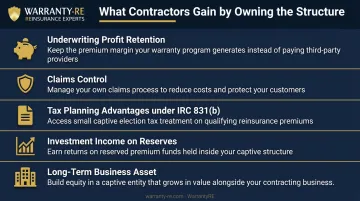
What Contractors Gain by Owning the Structure
- Underwriting profit retention — unused premium reserves stay in an account the contractor owns
- Claims control — the contractor manages the customer relationship from start to finish, with WarrantyRE handling all claims paperwork and adjudication
- Tax planning advantages — qualifying reinsurance companies with less than $2,900,000 in annual net premiums may elect to be taxed only on investment income under IRC 831(b), a meaningful benefit for contractors writing significant installation volume
- Investment income — reserve funds are managed by a Trust Company and invested in regulatory-approved instruments; once reserves exceed 125% of unearned premiums, funds may be invested more aggressively at the contractor's direction
- Long-term business asset — the reinsurance company is a financial entity with growing equity, not just an operating expense
Addressing Common Concerns
Contractors typically raise three objections before moving forward: setup complexity, ongoing administration, and compliance risk. Those happen to be the same three areas WarrantyRE manages entirely.
- Setup complexity — WarrantyRE handles company formation, legal filings, and all licensing requirements
- Ongoing administration — claims paperwork, adjuster coordination, and monthly financial statements are managed by WarrantyRE
- Compliance risk — tax returns for the reinsurance entity, renewals, and regulatory reporting are filed by WarrantyRE
Contractors stay focused on running installations and managing customer relationships.
The program also doesn't require large installation volume to start. WarrantyRE's materials explicitly address the misconception that contractors must be high-volume operations to make the structure worthwhile.
Frequently Asked Questions
What does an HVAC extended labor warranty typically cover?
Extended labor warranties cover technician labor costs for repairing or replacing major covered components when they fail under normal operating conditions. Covered parts typically include compressors, motors, coils, and control boards. Exclusions generally include installation defects, maintenance items, and failures caused by neglect or acts of nature.
How long do HVAC extended labor warranties usually last?
Coverage periods range from 1 to 10 years, with 5- and 10-year plans most common for new installations. The 10-year plan aligns with the manufacturer's registered parts warranty period, giving homeowners complete coverage across the same window.
What is the difference between an equipment warranty and a labor warranty?
Equipment warranties from manufacturers cover the cost of replacement parts when components fail due to defects — but not the technician's time to diagnose and install them. Labor warranties cover that technician cost separately, which can equal or exceed the part cost on major repairs.
Can an HVAC labor warranty be transferred to a new homeowner?
Transferability varies by program. Some ESAs allow full transfer when maintenance requirements are met and the administrator is notified within a set window, which can add real value at resale. Others are tied to the original purchaser only. Contractors should confirm transferability terms before selecting a program.
Do extended labor warranties require regular maintenance to stay valid?
Most ESAs require maintenance per manufacturer specifications, and proof may be requested when a claim is filed. Failure to maintain the system can give providers grounds to deny coverage. Pairing the warranty with an annual maintenance agreement protects both the homeowner's coverage and the contractor's reimbursement.
How do HVAC contractors get reimbursed for covered repairs?
The contractor submits a claim to the warranty administrator — typically including the invoice, work order, and customer signature. Payment is generally processed within 30 days based on the program's reimbursement schedule. Programs with built-in claims administration handle the full process, from first call through final resolution.