
Introduction
Warranty claims don't arrive on a schedule. One bad season — a product batch with higher failure rates, an unusually hot summer driving HVAC callbacks, or a roofing season with aggressive storm activity — can pull thousands of dollars directly from operating cash before a contractor has time to adjust. For contractors and dealers who are self-funding warranty obligations, that exposure is real and largely invisible until it hits.
Reinsurance is the mechanism the insurance industry has used for decades to give contractors and dealers a purpose-built financial structure for absorbing warranty risk — without every claim coming straight out of operating cash.
This guide breaks down how reinsurance protects cash reserves: how premiums flow into a dedicated reserve, how claims draw from that reserve instead of your operating account, and what it means to own and control that structure rather than hand premiums to a third party.
- How premium flow creates a separate claims reserve
- How claims draw from that reserve — not your operating cash
- What contractor ownership of that reserve means financially
TL;DR
- Reinsurance directs warranty premiums into a dedicated reserve, keeping claims away from operating cash
- A reinsurance backstop caps exposure when claims spike beyond what the reserve can absorb
- When claims run below projections, the surplus stays in the reserve — and in a contractor-owned structure, that money belongs to the business owner
- Four core functions — liability limitation, loss stabilization, catastrophe protection, and capacity expansion — each protect the reserve directly
- Contractors who own their reinsurance company stop funding third-party profits and start building a reserve they control
What Is Reinsurance?
The NAIC describes reinsurance as "insurance for insurance companies" — a contract in which one entity (the cedent) transfers risk to a reinsurer, which assumes all or part of the obligations under policies the cedent has issued. In the warranty context, it's the financial layer that sits behind every warranty contract a business issues to customers.
Individual businesses offering warranties face unpredictable claim volume. Some years are quiet; others produce a surge of claims that strains cash flow. Without a structured reserve and a risk-sharing layer, financial stability depends entirely on whether claim activity stays manageable — and that's not a strategy any business owner should rely on.
How the Structure Actually Works
Reinsurance is a deliberate financial structure, not simply a coverage purchase from a third party. The arrangement defines exactly how risk is transferred and reserves are maintained:
- Premiums are deliberately directed into a reserve mechanism
- The reinsurance agreement defines when, how, and how much of any claim burden shifts
- The cedent maintains a predictable and defensible financial position regardless of claim volume
That structure is what separates a business with a protected reserve from one that is absorbing claims directly from day-to-day cash flow.
How Reinsurance Protects Cash Reserves
Reinsurance protects cash reserves through a defined sequence: premiums flow in, a reserve accumulates, claims draw from that reserve in a controlled way, and a backstop limits how deeply any single event can drain the fund. Each step does specific work.
Premium Flow and Reserve Accumulation
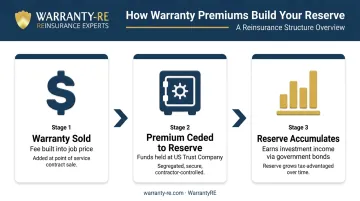
When a warranty or service contract is sold, the premium doesn't disappear into general operating funds. Under a reinsurance structure, a portion of each premium is ceded into a reserve held by the reinsurance entity.
In WarrantyRE's program, this works as follows:
- Warranty fees are built directly into job pricing
- Fees flow into the contractor's own reinsurance company account, held at a US Trust Company — not sent offshore
- The Trust Company invests reserve funds in conservative government bonds, so the reserve earns income while it accumulates
Consistent premium inflows, building over multiple job cycles, create a reserve that grows ahead of expected claim obligations. The reserve is there before claims arrive — not assembled in response to them.
Claims Are Paid From the Reserve, Not Operating Cash
When a covered claim comes in, it is paid from the reserve rather than from the business's operating account. That structural separation means the business account stays intact — a dedicated fund absorbs the hit instead.
WarrantyRE's Trust Agreement enforces this separation legally. Withdrawals from the trust are restricted to four purposes only:
- Payment of covered repair claims
- Limited professional fees
- Payment of income taxes
- Withdrawal of funds exceeding required reserves (with carrier approval)
Claims cannot simply be charged to the contractor's operating account — the structure routes them through the reserve by design. WarrantyRE handles all claims adjudication, managing every claim from first call through final resolution, so contractors don't need to coordinate adjusters or divert staff to warranty callbacks.
The Reinsurance Backstop for Large or Concentrated Claims
Even with a healthy reserve, unexpected claim surges can threaten reserve adequacy. A bad product batch, a concentrated install season, or an extreme weather event can generate claim volume that outpaces what the reserve can cover.
The reinsurance backstop addresses this directly. Per the Insurance Information Institute, excess-of-loss reinsurance is non-proportional: the primary entity retains a defined liability amount, and once claims exceed that retention, the reinsurer covers the excess. Depending on how the program is structured, that coverage can apply to:
- Individual large claims
- Specific loss events (such as a concentrated weather event)
- Aggregate annual losses across the book
In WarrantyRE's program, if the contractor's reinsurance company cannot meet its financial obligations, ultimate liability for claim payments rests with the direct writing insurance company. The contractor's exposure is limited to formation costs plus accumulated earnings. The A-rated carrier absorbs any shortfall beyond that.
The Four Core Functions of Reinsurance for Cash Reserve Protection
The Reinsurance Association of America identifies four reasons businesses use reinsurance. All four map directly to protecting cash reserves.
| Function | What It Does for the Reserve |
|---|---|
| Liability Limitation | Sets a defined retention level — claims above it shift to the reinsurer, keeping the reserve from being overwhelmed by a single large loss |
| Loss Stabilization | Smooths year-to-year claim volatility — good years build the reserve; bad years don't reverse it |
| Catastrophe Protection | Covers aggregate claim accumulation from a single event (product recall, widespread equipment failure), not just individual large losses |
| Increased Capacity | Because the reserve is backstopped externally, the business can grow warranty volume without the reserve needing to grow dollar-for-dollar with revenue |
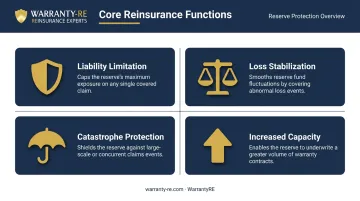
Each function targets a distinct failure mode — so a single structural gap can still leave the reserve exposed. Together, they cover the full range of conditions that pull operating cash out of a contractor's or dealer's business when no reinsurance program is in place.
How a Contractor-Owned Reinsurance Program Works
The Traditional Model vs. the Contractor-Owned Model
In the traditional model, a contractor sells a warranty backed by a third-party provider. Premiums leave the business, claims are handled externally, and any underwriting profit — the difference between premiums collected and claims paid — stays with the provider. As WarrantyRE puts it directly: if your third-party warranty provider weren't making a profit off you, why would they continue doing business with you?
In the contractor-owned model, the contractor establishes their own administrator-obligor reinsurance company. Premiums flow into that company's reserve. Any surplus belongs to the contractor.
How the Structure Is Set Up and Managed
The contractor's reinsurance company is backed by an A-rated carrier — which provides the compliance foundation and financial strength required to issue warranty contracts — while the contractor's company holds the premium reserve and owns the underwriting economics.
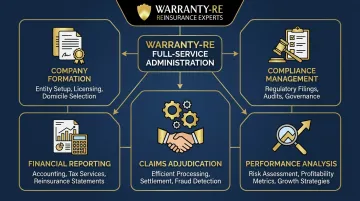
WarrantyRE handles the full setup and ongoing administration:
- Company formation — legal entity setup, licensing, state approvals
- Compliance management — all legal forms, filings, tax returns, and renewals
- Claims adjudication — every claim from first call through resolution
- Financial reporting — monthly statements, annual reports, tax preparation under IRC Section 831(b)
- Performance analysis — periodic reviews with the contractor to assess reserve health and program direction
That support extends into tax and legal territory as well. WarrantyRE partners with CPAs and legal counsel to ensure the program operates to the letter of the law — no shortcuts on IRS or state compliance.
Tax Treatment of the Reserve
Property and casualty insurance companies are taxed under special provisions of the Internal Revenue Code. Under IRC Section 831(b), companies collecting less than $2.9 million in annual net premiums can elect to be taxed only on investment income — not on premiums received. That means more of the annual premium stays in the reserve rather than going to federal income tax.
One important compliance note: IRS Notice 2016-66 identifies certain micro-captive structures as transactions of interest. The IRS can challenge arrangements where risk isn't genuinely spread across the insured base — meaning the program must operate as a real insurance structure, not a tax shelter. WarrantyRE addresses this directly:
- Programs are backed by A-rated carriers to establish genuine risk transfer
- Specialized tax counsel manages all 831(b) filings and state licensing
- No shortcuts are taken on structure or documentation
What Happens to Excess Reserves and Profits?
In years where claims run below projections, the reserve accumulates a surplus. In a contractor-owned reinsurance company, that surplus is the contractor's money.
The Trust Agreement allows withdrawal of funds exceeding required reserves — with carrier approval — meaning surplus that isn't needed to cover future claim obligations can be accessed by the contractor. That money can be:
- Distributed as profit
- Reinvested into the business
- Held to strengthen the reserve for future periods
- Managed as part of a broader tax and financial planning strategy
Because the reserve is held inside a legally separate reinsurance company, retained earnings may be treated differently than ordinary business income under IRC Section 831(b), as described above.
The reserve also earns investment income through the Trust Company's government bond allocations — so the fund builds value even in periods between premium inflows and claim activity.
With a third-party warranty provider, that dynamic works against you. When claims cost less than premiums collected, that difference becomes the external provider's profit — not yours. The contractor-owned structure puts that economic outcome where it belongs: on your side of the ledger.
Frequently Asked Questions
What are the four most important reasons for reinsurance?
The four core reasons are limiting liability on specific risks, stabilizing loss experience, protecting against catastrophic losses, and increasing underwriting capacity — each one designed to prevent claim volatility from depleting the business's financial reserves.
How does reinsurance specifically protect a contractor's cash reserves?
Reinsurance protects cash reserves by directing warranty premiums into a dedicated reserve fund, paying claims from that fund rather than from operating cash, and using a carrier backstop to cap exposure when claims spike — keeping the contractor's day-to-day finances insulated from claim activity in any given period.
What is the difference between a contractor-owned reinsurance company and a third-party warranty provider?
With a third-party provider, premiums leave the business and any underwriting profit goes to the provider. With a contractor-owned structure, premiums accumulate in the contractor's own reserve and any surplus — claims that don't happen — belongs to the contractor.
Can a small contractor or dealer benefit from owning their own reinsurance program?
Yes. Small and mid-size contractors qualify. The structure scales with the business, and the A-rated carrier backing provides compliance and financial strength from day one regardless of volume.
What happens to unused reserves when claims come in below projections?
In a contractor-owned reinsurance company, the surplus stays in the contractor's reserve. It can be distributed as profit, held to strengthen the reserve, or reinvested.
Is a contractor-owned reinsurance company compliant with insurance regulations?
Properly structured administrator-obligor programs are backed by licensed, A-rated carriers that provide the regulatory foundation for issuing warranty contracts. WarrantyRE manages all legal filings, compliance, state licensing, and renewals on behalf of the contractor — with full adherence to IRS and state requirements.