The confusion is understandable. Garage door protection comes from three separate layers: manufacturer warranties, installer labor warranties, and insurance or home warranty plans. Each has different triggers, different providers, and different limitations. Knowing which layer applies to which situation is the difference between a covered repair and an unexpected bill.
TLDR — Key Takeaways
- Manufacturer warranties cover material and workmanship defects — typically parts only, not labor
- Installer labor warranties typically run 1–2 years — most big-box installers cap coverage at one year
- Home warranty plans protect the garage door opener only — doors, tracks, and springs are excluded
- Homeowners insurance covers sudden damage from named perils — storm, fire, vandalism, vehicle impact — not wear and tear
- DIY repairs, skipped maintenance, and unauthorized parts are the most common reasons claims get denied
The Three Layers of Garage Door Warranty Coverage
Most homeowners assume one policy or warranty covers everything. It doesn't. The three layers don't overlap — each has a distinct provider, a different scope, and different conditions for triggering coverage.
Manufacturer Warranty
Manufacturer warranties are issued by the door or opener brand and cover defects in materials or workmanship that originate at the factory. Coverage duration varies significantly by component and model:
- Door panels/sections: 10 years to lifetime on Clopay steel doors; 1 year to lifetime across Amarr's model lineup
- Hardware: 3 years on Clopay WAR-C31; 10 years on WAR-C32
- Springs: 3 years standard (Clopay WAR-C31 and WAR-C32)
- Opener motors: Lifetime on select LiftMaster, Chamberlain, and Genie models
- Opener accessories: Typically 1 year
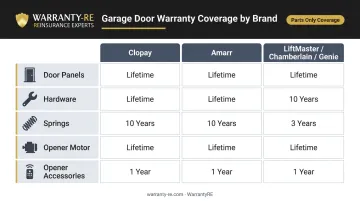
One critical detail: the major manufacturers — Clopay, Amarr, and Chamberlain — issue parts-only warranties. Clopay's warranty documentation confirms that replacement parts are provided at no cost, but labor for removal, reinstallation, and finishing is the customer's responsibility. Always verify whether your warranty is "parts only" or "parts and labor" before assuming a service call is covered.
Installer or Labor Warranty
When a door is hung incorrectly and comes off track, the manufacturer's warranty won't apply — that's the installer's problem to fix. The labor warranty is issued by the company that installed your door and covers the quality of the installation itself.
Large retailers set the baseline: both Home Depot and Lowe's publish a 1-year labor warranty on garage door installation. Independent contractors may offer more or less, but many informal labor guarantees have no documentation behind them at all.
The quality of this coverage varies enormously. Some contractors offer multi-year, formally documented programs. Others offer a verbal promise — which provides no recourse if they dispute a claim later.
Home Warranty Plans
Third-party home warranty plans — subscription services like American Home Shield or Choice Home Warranty — cover the garage door opener and its components, not the door structure itself.
American Home Shield's plan agreement explicitly covers electrically powered opener parts and extension/torsion springs. What's excluded: garage doors themselves, track assemblies, rollers, and guides. Choice Home Warranty follows the same pattern.
Before purchasing a home warranty plan for garage door coverage, confirm the exclusion list in writing. The opener motor may be covered; the door and track system almost certainly aren't.
What a Garage Door Warranty Typically Covers
Hardware and Moving Parts
Standard manufacturer warranties cover the core mechanical components. What "covered" typically means in practice:
- Door panels/sections: Repair or replacement of defective sections, with parts shipped at no cost
- Springs and spring components: Usually 3 years (Clopay standard); some premium model families include springs in lifetime coverage
- Hardware (hinges, brackets, cables, rollers): Covered for 3–10 years depending on model, grouped under general hardware coverage
The parts-only limitation is consistent across major brands. The part gets replaced — the technician who installs it is your expense.
High-cycle springs are worth asking about specifically when purchasing a new door. Some premium models include extended spring coverage beyond the standard 3-year term, which matters given how frequently springs are the first component to fail.
Garage Door Opener
Opener warranties are component-specific rather than a single blanket term. Using LiftMaster's 87504-267 as an example:
| Component | Coverage Term |
|---|---|
| Motor | Lifetime |
| Belt | Lifetime |
| Parts | 5 years |
| Accessories (remotes, sensors) | 1 year |
Chamberlain's B6753T follows a nearly identical structure. Genie's Model 7155 offers a limited lifetime motor and belt warranty.
The opener is the hardest-working component in the system. It runs every time the door moves, and electronic or mechanical failures within the first several years are common. When reviewing opener warranties, confirm whether lifetime motor coverage is truly unlimited or subject to conditions like proof of maintenance or a registered purchase.
Manufacturing and Material Defects
Beyond mechanical components, warranties also cover cosmetic and structural defects that originated during manufacturing — warping or bowing of panels, faulty welds, paint adhesion failures, and rust-through perforations. These are problems the homeowner had no role in creating.
Finish warranties vary by model and manufacturer:
- Clopay covers paint finish cracking, checking, or peeling and rust-through perforations for stated periods
- Amarr's paint warranty ranges from 5 years to lifetime depending on model (for example, Heritage 1000 carries 15 years; Classica 3000 carries lifetime)
Homeowners in coastal or high-UV climates should ask specifically about surface warranties. Clopay's warranty explicitly excludes salt spray, coastal weather exposure, and failure to properly clean in high-salt or acidic environments. If you're within a few miles of the ocean, the standard finish warranty may not apply.
What's Not Covered — and What Can Void Your Warranty
Common Exclusions
These exclusion categories appear consistently across major manufacturer warranty documents:
- Normal wear and tear: Springs, rollers, and cables that wear out over time are expected failures — not defects. Clopay explicitly excludes this category.
- Environmental damage: Rust from coastal air, UV fading, storm damage, and salt exposure are excluded from manufacturer warranties (though storm damage may be covered by homeowners insurance).
- Cosmetic wear: Minor scratches, normal fading, and small dents from everyday use are not warranty events.
- Electrical surges: Power fluctuations that damage opener circuit boards fall outside standard warranty terms. A surge protector is a low-cost way to reduce this risk.
- Accidental damage: A vehicle backing into the door, a stray ball cracking a panel, or a broken window — none of these are warranty events. They belong to homeowners insurance.
Actions That Void Coverage
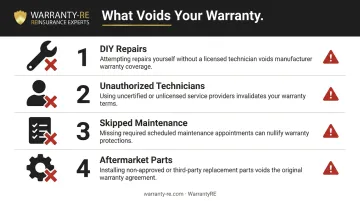
Three actions consistently trigger warranty denial:
- DIY repairs or modifications — Most manufacturers require all service work to be performed by authorized technicians. Even minor self-adjustments to spring tension can void coverage.
- Hiring unauthorized technicians — Using a general handyman instead of a certified garage door professional typically invalidates the warranty. Both Clopay and Amarr cite improper installation as grounds for denial.
- Skipping required maintenance — Clopay's warranty explicitly excludes "failure to follow maintenance instructions." Neglecting lubrication, balance checks, and hardware tightening gives manufacturers documented grounds to deny a claim.
- Using aftermarket or incompatible parts — Amarr's residential warranty specifically voids coverage for alterations or additions not shown in manufacturer instructions. Cheaper springs or non-approved sensors introduce variables outside tested specifications.
How Homeowners Insurance Fills the Gaps
Homeowners insurance covers what warranties don't — but only for specific named events, not general wear or deterioration. An attached garage door is typically covered under the dwelling section of a standard homeowners policy; a detached garage falls under other-structures coverage.
Covered events that typically apply to garage doors:
- Fire
- Windstorm and hail (panel dents, cracked windows, doors blown off track)
- Lightning strikes, including surge damage to openers
- Falling objects such as tree limbs during storms
- Vandalism or break-in damage — dents from forced entry, smashed panels, tampered keypads (a police report is usually required)
Vehicle impacts come up often. If a car backs into the garage door, damage to the door structure goes through homeowners insurance. Damage to the car itself is a separate auto insurance question — and if you caused the damage to your own property, your auto insurer generally won't cover the door repair.
What insurance won't cover: wear and tear, manufacturer defects, or aging components. Those fall under your manufacturer or installer warranty — which is why understanding what each coverage type actually protects is worth knowing before you need to file a claim.
Which Coverage Applies? A Quick Decision Guide
| Situation | Coverage Layer |
|---|---|
| Part failed with no external cause, within warranty period | Manufacturer warranty |
| Door came off track after installation | Installer/labor warranty |
| Opener mechanical breakdown (plan active) | Home warranty plan |
| Storm, fire, vandalism, or vehicle impact | Homeowners insurance |
| Normal aging, cosmetic wear | Out-of-pocket — no coverage |
Keep these documents in one accessible place:
- Original purchase receipt and model documentation
- Manufacturer warranty terms (specific to your door model)
- Installer warranty in writing
- Home warranty plan agreement
- Homeowners insurance declarations page
Having these on hand before something breaks means you can file a claim quickly and avoid finding out coverage gaps exist only after you need them.
For Garage Door Contractors: Why Your Warranty Program Matters
The warranty a garage door contractor offers isn't just a customer service detail. It directly affects trust, repeat business, and long-term profitability.
Contractors who rely on third-party warranty providers are sending a portion of their revenue to an outside company — one that profits from the gap between premiums collected and claims paid. That profit belongs to the contractor.
WarrantyRE works with home service contractors across trades, including garage door, HVAC, roofing, plumbing, and electrical, to replace third-party warranty arrangements with contractor-owned reinsurance programs. Instead of premiums flowing out to an outside provider, warranty fees are built into job pricing and flow into the contractor's own reinsurance structure.
When claims arise, they're covered from that pool. When they don't, the money stays with the contractor.
The program handles the administrative side in full, so contractors control the customer experience without the overhead. That includes:
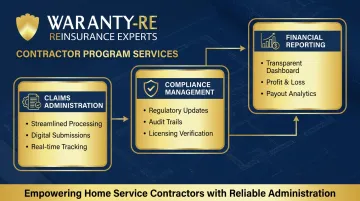
- Claims administration and adjudication
- Compliance management and legal filings
- Financial reporting and bookkeeping
Founded in 1994 by Tim Byrd, WarrantyRE has helped business owners across home service industries build more profitable warranty structures for over 30 years — a track record that gives contractors confidence the program is built to hold up long-term.
Contractors interested in building a stronger, more profitable warranty program can reach WarrantyRE at (804) 824-9533 to explore whether a contractor-owned reinsurance structure makes sense for their business.
Frequently Asked Questions
Does homeowners insurance pay for garage door repair?
Yes — when damage results from a covered peril such as a storm, fire, vandalism, or vehicle impact. Homeowners insurance does not cover normal wear and tear, manufacturer defects, or aging components. Those scenarios fall under the manufacturer or installer warranty.
What does a garage door manufacturer warranty typically cover?
Manufacturer warranties cover defects in materials and workmanship — faulty panels, hardware, springs, and opener components. Door sections often carry 10-year to lifetime coverage; premium opener motors may be lifetime as well. Labor for replacement parts is almost always excluded unless the warranty explicitly states otherwise.
What voids a garage door warranty?
The three most common voiding actions are: performing DIY or unauthorized repairs, using incompatible or aftermarket parts, and failing to perform routine maintenance as specified in the warranty terms. All three are explicitly documented as exclusion grounds by major manufacturers including Clopay and Amarr.
Is the garage door opener covered under a home warranty plan?
Most home warranty plans cover the opener motor, sensors, and remotes, but not the door panels, tracks, springs, or structural components. American Home Shield and Choice Home Warranty both explicitly exclude door and track assemblies — so read the inclusion list carefully before assuming full coverage.
Can a garage door warranty be transferred to a new homeowner?
Generally, no. Clopay and Amarr warranties apply only to the original purchaser and are non-transferable; Genie and Chamberlain opener warranties follow the same rule, covering only the first retail purchaser at the original installed residence. Always verify the specific manufacturer document before claiming transferability during a home sale.
What components of a garage door are NOT covered by a home warranty?
Most home warranty plans exclude door panels, hinges, tracks, rollers, and cables — coverage is limited to the opener and its electrical and mechanical components. The physical door and track assembly are almost universally excluded, so don't assume the entire system is protected.