Introduction
HVAC contractors are sitting on an underserved market. Maintenance contracts captured 39% of HVAC industry revenue in 2024, yet only 25% of U.S. homeowners currently hold service agreements. That 75% gap represents a massive addressable opportunity — especially given that homeowners underestimate lifetime maintenance costs by over $250,000, according to a Synchrony home services study.
Selling equipment and labor alone creates a transactional relationship that ends at installation. Extended warranty programs create recurring revenue streams and deeper customer loyalty — but only when paired with the right partner.
Choosing poorly costs more than it earns. Some programs saddle contractors with slow claims processes, low payout limits, or profit-sharing structures that quietly erode margin.
Not every HVAC extended warranty program is structured with contractors in mind. This guide evaluates the top options based on coverage breadth, claims speed, contractor support, underwriter financial strength, and profit structure — so you can find a partner that improves your margins, not just your paperwork.
TL;DR
- Extended warranty programs create recurring revenue beyond one-time installations
- Top programs offer fast claims, solid coverage terms, and clear markup structures for contractors
- When comparing providers, weigh coverage depth, claims turnaround speed, and the financial strength of the underwriting insurer
- Third-party programs are common, but contractor-owned reinsurance programs let you keep the underwriting profits instead of paying them to a third party
- Check insurer AM Best ratings and plan exclusions — the fine print determines whether a program actually protects your business
What Is an HVAC Extended Warranty Program for Contractors?
An HVAC extended warranty program is a service agreement sold to homeowners at the point of installation, covering repair or replacement costs beyond the manufacturer's warranty period. Unlike manufacturer warranties — which typically cover parts only for 5-10 years and exclude labor entirely — contractor-sold extended warranties fill the labor coverage gap and often extend protection on critical components like compressors, heat exchangers, and ductwork.
The contractor business model: You purchase or white-label a program from a third-party warranty administrator, mark it up for resale to homeowners, and earn either a dealer margin or revenue share on premiums collected. The administrator handles claims processing, compliance, and customer service while you capture the profit spread.
The market behind these programs is substantial. Key figures show just how much demand exists:
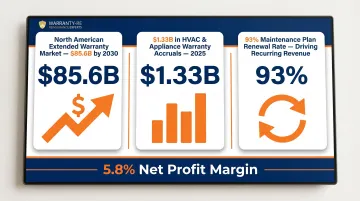
- The North American extended warranty market is projected to reach $85.6 billion by 2030 at a 9.5% CAGR
- The Appliances and HVAC segment generated $1.33 billion in warranty accruals in 2025 alone, per Warranty Week's 23rd Annual Product Warranty Report
- That same segment saw $1.18 billion in warranty claims among U.S. manufacturers last year
For contractors operating at the median 5.8% net profit margin (per the 2024 ACCA Financial Benchmarking Study), extended warranty programs add revenue without adding labor costs. Industry benchmarks show a 93% maintenance plan renewal rate — turning one-time installs into multi-year recurring revenue streams.
Best HVAC Extended Warranty Companies for Contractors
Each company below was evaluated on what matters most to contractors: coverage quality, claims experience, support infrastructure, underwriter financial strength, and profit structure.
Warrantech (Amynta Group)
Warrantech operates as a subsidiary of The Amynta Group and benefits from AmTrust Financial Services' insurance carrier network. AmTrust's affiliated carriers — including Wesco Insurance Company as the primary underwriter — carry an AM Best rating of "A-" (Excellent), Financial Size Category XV, with a Stable Outlook. This provides strong financial security backing for contractor warranty programs.
What makes Warrantech stand out: The AM Best "A-" rating offers contractors confidence in long-term claim solvency. Warrantech's nationwide contractor network support and established infrastructure provide scale and stability. That said, Warrantech's public-facing materials emphasize automotive, recreational, and powersports industries rather than HVAC specifically.
HVAC coverage exists within the broader Consumer Product Purchases division, but detailed program terms are not publicly available.
| Coverage Scope | Dealer Profit Structure | Claims Process |
|---|---|---|
| Major appliances and home systems including HVAC components; specific component inclusions/exclusions not publicly documented | Dealer markup and profit-sharing structures available; specific percentages require direct inquiry | Established claims infrastructure with dedicated customer service; turnaround benchmarks not publicly specified |
Best for: Contractors who prioritize strong underwriter financial backing and want an established warranty administrator with national reach.
National Service Alliance (NSA)
NSA operates as part of Ironwood Warranty Group and brings 18+ years of direct OEM service experience to the HVAC space. The company is a founding member of the National Home Service Contract Association (NHSCA) Advisory Board, which reflects meaningful involvement in how industry standards are set.
Where NSA differentiates: NSA maintains a national field service network of fully vetted, insured HVAC technicians covering all U.S. metropolitan and secondary markets, including Alaska, Hawaii, and Puerto Rico. The company's HVAC-specific focus means they understand the nuances of compressor failures, refrigerant leaks, and heat exchanger cracks. NSA also provides triage diagnostic services that reduce unnecessary truck rolls, keeping dispatch costs down for contractors.
| Coverage Scope | Dealer Profit Structure | Claims Process |
|---|---|---|
| HVAC, plumbing, and electrical systems; includes parts warehousing and distribution support | Specific revenue-sharing percentages not publicly available; requires direct program documentation | Online portal for claims submission; contractors close repairs through the portal and receive weekly direct deposit with no invoicing required |
Best for: HVAC-focused contractors who want an administrator with deep industry expertise and a dedicated field service network.
Residential Warranty Company (RWC)
RWC positions itself primarily as a home builder warranty company, offering traditional "1-2-10" new home warranty structures. Through its Key Estates Warranty brand, RWC extends coverage to HVAC systems, appliances, and home systems in new homes.
How RWC serves contractors: Key Estates allows homeowners to use a repair provider of their choice rather than restricting service to a limited network. This flexibility can improve customer satisfaction and reduce friction during claims. RWC's builder-centric orientation means the program integrates naturally into new construction workflows.
Key Estates Warranty Pricing:
| Service Fee | 2-Year Term | 3-Year Term | 5-Year Term |
|---|---|---|---|
| $25 | $275 | $415 | $550 |
| $50 | $220 | $360 | $495 |
| $100 | $195 | $330 | $470 |
Standard coverage includes cooling systems, heating systems, ductwork, electrical systems, plumbing systems, and major appliances. Higher service fees (deductibles) correspond to lower premiums, allowing contractors to match price points to local market conditions.
| Coverage Scope | Dealer Profit Structure | Claims Process |
|---|---|---|
| HVAC (cooling, heating, ductwork), electrical, plumbing, major appliances; marketed for systems in new homes | Contractor compensation structures not publicly documented | Homeowner files claims directly; specific resolution timelines not published |
Best for: Contractors working with production home builders or in new construction markets.
ServiceBench (Asurion)
ServiceBench is a technology platform, not a warranty underwriter. Owned by Asurion, it operates as cloud-based field service management software connecting enterprise warranty programs with field service networks.
What ServiceBench offers contractors: ServiceBench provides automated claims processing, real-time service event tracking, workforce management with technician qualification matching, and tech tools for field operations. The platform's HVAC relevance is demonstrated through its deployment with Tradewinds Climate Systems, the world's largest manufacturer of specialized HVAC products. According to a February 2017 press release, Tradewinds converted from legacy paper-based claims to ServiceBench within 90 days, virtually eliminating manual processes.
| Coverage Scope | Dealer Profit Structure | Claims Process |
|---|---|---|
| Platform supports HVAC manufacturer and administrator warranty programs; coverage depends on the specific program | ServiceBench is a technology platform used by warranty administrators and OEMs; contractors interact as service providers rather than program owners | Cloud-based portal with real-time claims tracking, automated workflows, and digital documentation; 90-day deployment timelines demonstrated in case studies |
Best for: Contractors servicing OEM or administrator warranty networks who need to understand the claims technology they'll interact with.
Trane Technologies Extended Warranty Program
Trane offers manufacturer-backed extended warranties available exclusively through authorized Trane dealers. The program extends coverage beyond Trane's standard limited warranties, which cover 10 years on parts (if registered within 60 days) and 20 years on heat exchangers, but exclude labor.
What Trane's program offers dealers: Manufacturer credibility, guaranteed parts availability, and brand recognition create a strong sales differentiator at the point of installation. For authorized dealers, Trane's extended warranty — particularly the optional labor coverage — fills the gap that manufacturer warranties don't address. Dealers use ComfortSite, Trane's extranet platform, for warranty management, equipment ordering, and training resources.
Commercial Extended Warranty Options: Trane offers commercial extended warranties ranging from two months to 25 years, depending on equipment type, which dealers must purchase before the equipment ships.
| Coverage Scope | Dealer Profit Structure | Claims Process |
|---|---|---|
| Whole-unit parts warranty, compressor-only warranty, and optional extended labor warranty covering work performed by authorized technicians; varies by residential vs. commercial equipment | Specific dealer margin/commission percentages not publicly documented | Dealer diagnoses issue, contacts parts supplier for replacement components, and submits claim through the parts supplier; ComfortSite extranet provides warranty management tools |
Best for: Authorized Trane dealers who want to leverage manufacturer credibility and capture labor warranty revenue on Trane installations.
How We Chose the Best HVAC Extended Warranty Companies
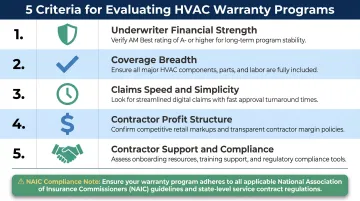
Evaluation criteria included five core dimensions:
Underwriter Financial Strength
Prioritize companies backed by A-rated insurers (per AM Best). An "A-" (Excellent) rating or higher signals a strong ability to meet ongoing claim obligations. Avoid programs with no verifiable insurer backing or those relying on undercapitalized obligors.
Coverage Breadth
The best programs cover common HVAC failure points:
- Compressors and heat exchangers
- Refrigerant leaks
- Ductwork and labor costs
Programs with extensive exclusions or low aggregate claim limits reduce customer value and create reputational risk for contractors.
Claims Speed and Simplicity
Fast adjudication — weekly payment cycles, online portals, minimal documentation — reduces administrative burden. Slow processing or high denial rates erode customer satisfaction and damage your credibility.
Contractor Profit Structure
We evaluated transparency and competitiveness of markup models, revenue-sharing arrangements, and commission structures. Programs that bury fees in complex agreements or offer minimal dealer margin won't generate real profit.
Contractor Support and Compliance
Look for dedicated account management, sales training, marketing materials, and compliance support — these are what help contractors monetize a program rather than just administer it.
Also verify that administrators hold appropriate service contract licenses and maintain required financial reserves per the NAIC Service Contracts Model Act, which requires either $100 million+ net worth or a reimbursement insurance policy from a qualified insurer.
Common mistake: Contractors often choose programs based solely on premium price — without checking coverage exclusions, claims denial rates, or underwriter stability. A cheap program with a 40% denial rate costs more in customer goodwill than a premium-priced program with fast, transparent claims.
Should HVAC Contractors Consider Owning Their Own Warranty Program?
Rather than selling third-party warranties and keeping only the dealer markup, some HVAC contractors establish their own administrator-obligor reinsurance companies. This structure allows contractors to capture the full underwriting profit — the difference between premiums collected and claims paid — instead of passing it to a third-party warranty provider.
How a Reinsurance-Backed Warranty Program Works
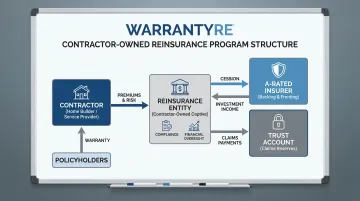
In a reinsurance model, the contractor owns a separate reinsurance company that collects premiums from customers on every HVAC installation. These customer-funded reserves build a pool that covers labor warranty claims when they arise. The contractor retains 100% of underwriting profits (premiums minus claims), plus any investment income earned on reserves held in trust.
Critically, the structure is backed by A-rated insurers for catastrophic claim exposure. If claims exceed reserves, the insurer absorbs the shortfall — limiting contractor liability to formation costs plus accumulated earnings. Day-to-day claims are paid from the contractor's reserve account under a formal Trust Agreement between the underwriting insurance company, the reinsurance company, and a Trust Company.
Economics and scale: Warranty programs typically experience loss ratios between 50% and 76%, meaning 24% to 50% of each premium dollar flows as underwriting profit. The three profit layers include:
- Front-end retail markup on premiums sold to customers
- Underwriting spread (premiums minus claims paid)
- Investment income on reserves held in trust
Programs with annual net premiums under $2.2 million may qualify for IRC 831(b) tax elections, providing favorable tax treatment on underwriting income. This model works best for contractors with sufficient installation volume to support a self-funded program — automotive industry benchmarks suggest 30+ units per month as a minimum threshold, though HVAC-specific requirements may differ due to lower individual premiums and different claims patterns.
WarrantyRE: The Reinsurance Partner for HVAC Contractors
WarrantyRE (warrantyRE.com) has been helping home service contractors — including HVAC contractors — establish and manage their own reinsurance-backed warranty companies since 1994. Their full-service model lets contractors focus on installations while capturing 100% of the underwriting profits their customer base generates. Administration includes:
- Company formation and regulatory filings
- Claims adjudication and loss monitoring
- Tax returns and monthly financial statements
- Periodic owner advisory meetings and performance reporting
WarrantyRE's structure creates a legally distinct reinsurance entity owned by the contractor, backed by A-rated insurers, and governed by a formal Trust Agreement that ensures regulatory compliance. Contractors retain full ownership while WarrantyRE handles every filing, financial report, and compliance requirement behind the scenes.
This differs from pure self-insurance, where contractors absorb catastrophic losses with no backup. WarrantyRE's administrator-obligor model adds A-rated insurer backing and structured tax advantages — without requiring contractors to manage any of the legal or compliance work themselves.
Conclusion
The right HVAC extended warranty partner should match your business model. Coverage terms, claims speed, underwriter financial stability, and profit structure all directly affect how much revenue the program generates. A program that denies 30% of claims or takes 60 days to pay will quietly drain customer trust — and that loss rarely shows up in the margin math until it's too late.
Doing your due diligence upfront protects both your profit and your reputation. Before signing with any warranty administrator:
- Review sample contracts for exclusions and aggregate claim limits
- Ask for references from other HVAC contractors in your region
- Confirm the underwriter's AM Best financial rating (look for "A-" or better)
- Request claims approval rates and average turnaround times
- Calculate your actual profit after administrator fees and claims reserves
Contractors who want to go beyond third-party programs and build a warranty revenue stream they own outright can reach out to WarrantyRE to learn how the reinsurance model works for HVAC contractors nationwide. Call (804) 824-9533 or visit warranty-re.com/contact-us/ to request a free owner analysis.
Frequently Asked Questions
Who has the best warranty for HVAC systems?
The "best" warranty depends on whether you're evaluating manufacturer warranties (Trane, Carrier, Lennox) or third-party extended programs sold through contractors. Manufacturer warranties cover parts only (typically 10 years if registered), while contractor-sold extended warranties cover labor and components beyond the manufacturer term.
What is the $5,000 rule for HVAC?
The $5,000 rule is a decision heuristic: multiply the repair cost by the system's age in years — if the result exceeds $5,000, replacement typically offers better ROI than repair. For example, a $400 repair on a 14-year-old system yields $5,600, signaling replacement — which is why extended warranties deliver the most value on newer systems that fall below the threshold.
Who is the highest rated home warranty company?
Home warranty companies like American Home Shield and Choice Home Warranty serve homeowners directly and position contractors as interchangeable service providers. HVAC contractors work with B2B warranty administrators like Warrantech or NSA, which operate through dealer channels and allow contractors to own customer relationships and capture profit. These are distinct markets with different structures, incentives, and evaluation criteria for contractors.
What is the difference between a manufacturer warranty and an extended HVAC warranty sold by a contractor?
Manufacturer warranties cover defects in materials or workmanship for a set period (typically 5-10 years on parts, 20 years on heat exchangers) but exclude labor. Contractor-sold extended warranties cover labor, parts, and system failure beyond the manufacturer term — often including priority service — which adds value for homeowners and margin for contractors.
How do HVAC contractors make money selling extended warranties?
Contractors earn through two models: the dealer markup model (buying wholesale from a warranty administrator and selling retail, keeping the spread) and the reinsurance model (owning the warranty company and retaining underwriting profits). The reinsurance model typically generates significantly more revenue for contractors with sufficient installation volume.