
Captive insurance offers an alternative. By owning or participating in a licensed insurance entity, contractors retain underwriting profits that would otherwise flow to third-party carriers, gain control over claims handling, and reduce long-term costs. But the right captive partner makes all the difference—choosing poorly can expose contractors to compliance risk, inadequate financial backing, or administrative nightmares.
TLDR
- Captive insurance lets contractors self-insure through a licensed entity, keeping profits that would otherwise go to commercial insurers
- Group captives are the most accessible entry point for mid-market contractors covering workers' comp and liability
- For home service contractors, specialty reinsurance programs apply the same captive concept to labor warranty coverage
- When comparing providers, prioritize AM Best ratings, hands-on contractor experience, claims support, and fee transparency
- Leading options: Captive Resources, Strategic Risk Solutions, ACIG, Hylant Global Captive Solutions, and WarrantyRE
What Is Captive Insurance for Contractors?
Captive insurance is a licensed, self-insurance vehicle where a company—or group of companies—owns the insurer rather than purchasing coverage from a commercial carrier. Contractors use captives to manage the high-premium lines that hit their balance sheets hardest: workers' comp, general liability, auto liability, and increasingly, warranty obligations.
The financial logic is straightforward. Commercial insurers price in overhead, profit margins, and loss reserves that contractors never see again. Captive structures return those underwriting profits to business owners. Between 2019 and 2024, AM Best-rated U.S. captives preserved an estimated $6.6 billion for owners compared to commercial alternatives, posting a five-year average combined ratio of 88.0 versus 97.0 for commercial casualty peers.
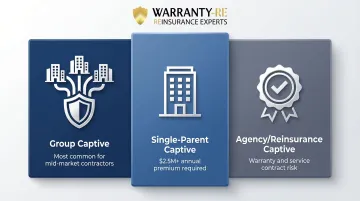
Three captive structures matter most for contractors:
- Group captives — Multiple unrelated companies pool risk in a jointly owned insurer. Most common for mid-market contractors; members pay premiums based on their own loss history and receive dividend returns when the captive performs well.
- Single-parent captives — A contractor owns its insurance subsidiary outright. Typically requires $2.5M+ in annual premium volume to justify formation costs and capitalization.
- Agency/reinsurance captives — Contractors own the warranty company behind their labor guarantees. This structure is separate from P&C coverage and particularly relevant for home service contractors managing warranty risk.
These structures vary significantly in setup cost and complexity. That range is reflected in the captive market's overall growth.
The captive market is substantial and growing. The U.S. domestic captive count reached 3,466 in 2024, with 6,290 captives licensed worldwide. Vermont alone added 51 new captives in 2025, bringing its active total to 707.
Best Captive Insurance Companies for Contractors
Choosing the right captive insurance partner can mean the difference between owning your risk and simply renting it. These companies were evaluated for contractor-specific experience, coverage capability, financial strength, administrative services, and ability to serve middle-market through enterprise-level businesses.
Captive Resources
Captive Resources is a 40+ year veteran of member-owned group captive management, advising mid-market companies across industries with a particularly strong track record serving contractors through P&C group captives that pool workers' compensation, general liability, and auto liability risk.
What sets them apart: the member-owned structure means contractors become insurance company owners, not just buyers. The company manages 48 casualty captives with more than 6,700 member companies, $4.7 billion in annual premiums, and has returned more than $4 billion in dividends to members. This demonstrates both financial depth and operational maturity. Captive Resources was ranked #2 in Business Insurance's Best Places to Work for medium employers in 2024—the 8th consecutive year on the list—reflecting organizational stability that translates into consistent service.
| Coverage Focus | Workers' compensation, general liability, auto liability (P&C group captives) | | Best For | Mid-market contractors seeking to pool risk with similar businesses and earn dividend returns | | Key Differentiator | Member-owned governance model; consistently ranked among Best Places to Work in Insurance |
Strategic Risk Solutions (SRS)
Strategic Risk Solutions is the #1 ranked captive management company in the industry according to Captive Review's Power 50, with global operations and a hands-on leadership approach. They serve a broad range of industries including construction and contracting, with expertise spanning all major captive domiciles—the U.S., Bermuda, Cayman Islands, Canada, and Europe.
SRS stands out for rapid expansion while retaining direct client access at every level. The firm is recognized for recruiting top captive industry talent and building advanced operational systems, making them a strong fit for contractors who want institutional-grade captive management without losing responsiveness. Founded in 1993, SRS is the fourth-largest captive manager worldwide and the largest independent manager not affiliated with a brokerage.
| Coverage Focus | Broad captive management across P&C lines; custom structure design for single-parent and group captives | | Best For | Contractors and construction businesses seeking full-service captive formation, management, and compliance | | Key Differentiator | #1 ranked captive management firm; global reach with domicile expertise across multiple jurisdictions |
American Contractors Insurance Group (ACIG)
ACIG is one of the few captive insurance groups built exclusively for the construction industry, offering workers' compensation, general liability, automobile liability, and financial guaranty coverage through a Bermuda-domiciled parent structure with an AM Best A (Excellent) rating.
Industry-exclusive focus means underwriting, claims supervision, risk management, safety, and quality services are all tailored to contractor operations. ACIG has won the CICA Outstanding Captive Award and their A-rated financial strength provides added assurance for bonding and compliance requirements contractors often face. The group achieved a 54% reduction in workers' comp loss rates and an 80% reduction in general liability loss rates over a 16-year period through their Project Lifesaver initiative.
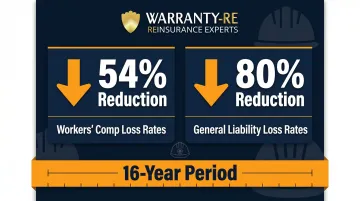
ACIG was founded in 1981 by three construction companies and now serves 39 active member companies with $3.3 billion in construction payroll insured.
| Coverage Focus | Workers' comp, general liability, auto liability, financial guaranty—construction-exclusive | | Best For | Mid-to-large construction contractors who need a contractor-dedicated captive with proven financial strength | | Key Differentiator | AM Best A-rated; CICA Outstanding Captive Award recipient; built solely for the construction industry |
Hylant Global Captive Solutions
Hylant is a growing force in captive insurance management with an expanding global footprint, led by a team recognized in the Captive Review Power 50. They serve middle-market companies including contractors looking for custom captive structures. Their construction team brings over 325 years of combined risk management experience to the table.
Hylant's strength lies in underwriting flexibility and complementary captive services—they can help contractors design coverage for risks that may be unavailable through conventional carriers. The firm won the Captive Manager (less than $1bn GWP) award at the 2025 Captive Review US Awards and was shortlisted again in 2026. Their commitment to education and advocacy in the captive industry adds value for contractors new to captive structures.
| Coverage Focus | Custom P&C captive structures; access to coverage for hard-to-insure contractor risks | | Best For | Contractors entering the captive market for the first time or seeking non-standard coverage solutions | | Key Differentiator | Recognized global captive leadership; strong onboarding and education resources for new captive members |
WarrantyRE
WarrantyRE is a specialist reinsurance company founded in 1994, serving home service contractors—HVAC, roofing, plumbing, electrical, and general contractors—by helping them establish and manage their own administrator obligor reinsurance companies to replace third-party warranty providers and capture underwriting profits.
Unlike P&C group captives, WarrantyRE's model targets warranty and service contract risk specifically. Contractors stop paying warranty profits to third parties and instead fund their own reinsurance entity backed by A-rated insurers. Full-service administration includes:
- Claims adjudication and compliance management
- Financial reporting and bookkeeping
- Tax returns and annual renewals
- Staff training and onboarding
- No hidden fees at any stage
The structure works by building warranty fees directly into job pricing. A $12,000 HVAC system replacement or a $15,000 roofing job includes a warranty fee that flows into the contractor's own reinsurance account rather than a third-party provider. When claims occur, they're paid from this customer-funded reserve pool. Unused funds stay with the contractor—turning warranty operations into a recurring profit center.
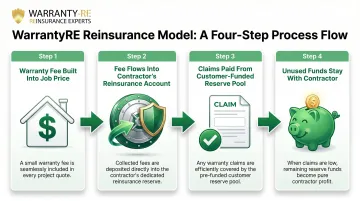
WarrantyRE has served 400+ clients across the U.S., bringing over 30 years of reinsurance expertise from the automotive dealer market into the home service contractor space.
| Coverage Focus | Warranty and service contract reinsurance for home service contractors (HVAC, roofing, plumbing, electrical) | | Best For | Contractors currently paying third-party warranty providers who want to own their own warranty company and capture 100% of underwriting profits | | Key Differentiator | Over 30 years of reinsurance expertise; admin obligor structure backed by A-rated insurers; full-service setup, compliance, and bookkeeping handled by WarrantyRE |
How We Chose the Best Captive Insurance Companies for Contractors
The most common mistake contractors make is selecting a captive partner based solely on brand recognition or premium savings projections, without evaluating the provider's contractor-specific experience, administrative depth, financial ratings, and ability to support compliance over the long term.
Core selection factors:
- AM Best or equivalent financial strength rating – Critical for bonding requirements and regulatory confidence
- Demonstrated experience serving construction and home service sectors – Industry-specific knowledge prevents costly missteps
- Scope of coverage offered – Does the captive handle your highest-risk lines?
- Quality and completeness of administrative services – Claims, compliance, reporting, and investment management
- No hidden fees — confirm all costs upfront before signing
- Built-in scalability so the structure grows as your business does
According to the Insurance Information Institute, approximately 75% of new group captive policies have lower costs than members' previous commercial plans, with roughly 30% seeing savings of 20% or more. Those numbers are real — but they depend entirely on the management company behind the structure.
Captive structures only deliver on that promise when the manager has the infrastructure to handle underwriting, loss control, regulatory filings, and investment management consistently.
That execution doesn't stop at formation. Monthly financial statements, owner advisory meetings, and transparent loss ratio tracking are what separate professional captive managers from those who disappear once the paperwork is signed.
Conclusion
The right captive insurance partner depends on the type of risk you need to manage:
- P&C group captives (Captive Resources, Strategic Risk Solutions, ACIG, Hylant) — best for workers' comp and general liability, offering dividend returns and shared risk pools for mid-market contractors
- Warranty reinsurance programs (WarrantyRE) — best for home service contractors losing profits to third-party warranty providers, enabling them to own their warranty company and keep 100% of underwriting profits
Many contractors benefit from both.
The next step is straightforward. Assess your current insurance and warranty spend, calculate how much walks out the door in premiums each year, and consult with a captive specialist before your next renewal cycle.
Home service contractors ready to stop funding someone else's profits can start with a business analysis from WarrantyRE. Setup is straightforward, fees are disclosed upfront, and the program is backed by A-rated insurers — with over 30 years of reinsurance experience behind it.
Frequently Asked Questions
How much does a captive management fee cost?
Captive management fees vary by structure and provider. Expense ratios for captives averaged approximately 9% over 2016-2020, compared to approximately 31% for traditional insurers. Full-service providers like WarrantyRE include administration, compliance, and bookkeeping in their programs with no hidden additional fees. Consult directly with captive managers for specific pricing.
What's the best insurance for contractors?
The best insurance depends on the contractor type. Home service contractors often benefit from pairing traditional general liability and workers' comp with a warranty reinsurance program to capture underwriting profits. Construction contractors typically prioritize group captive participation for P&C lines when commercial premiums run high.
What are the top captive insurance management companies?
Top captive management companies include Captive Resources, Strategic Risk Solutions, ACIG (construction-exclusive, AM Best A rated), Hylant Global Captive Solutions, and specialty reinsurance providers like WarrantyRE for warranty coverage. Rankings vary by industry focus and captive type.
Which companies use captive insurance?
Captive insurance is used by mid-to-large businesses across construction, manufacturing, healthcare, and financial sectors. Nearly all Fortune 500 companies use some form of captive. Captive premiums now account for a significant share of commercial insurance globally, with 6,290 captives licensed worldwide. Contractors represent a growing segment, driven by rising commercial premiums and nuclear verdicts.
What is 831(b) captive insurance?
Section 831(b) of the Internal Revenue Code allows small captive insurance companies (micro-captives) to be taxed only on investment income rather than premium income, up to $2.9 million annually for 2026. Micro-captives have faced IRS scrutiny: final regulations in January 2025 designated arrangements with loss ratios below 30% as listed transactions, making compliance planning essential.
What are the two major types of captive insurance companies?
The two major types are single-parent captives (one company owns and insures its own risks, typically requiring $2.5 million+ in annual premium) and group captives (multiple unrelated companies pool risk together in a jointly owned insurer). A third relevant type for contractors is agency/reinsurance captives, used for warranty and service contract programs like those offered by WarrantyRE.