This guide walks roofing contractors through the top underlayment brands available today, what differentiates them, and what to evaluate before committing to a product line. Whether you're spec'ing asphalt shingles, metal panels, or tile assemblies, the underlayment you install determines whether your roof system performs as promised or fails prematurely.
TL;DR
- Roofing underlayment protects against water infiltration, wind-driven rain, and UV exposure beneath the final roofing material
- Top brands include GAF, Owens Corning/InterWrap, CertainTeed, GCP Applied Technologies (Grace), and Sharkskin
- UV exposure ratings range from 30 days (Grace Select) to 12 months (Sharkskin Ultra)—a key spec for projects where final materials won't install immediately
- Synthetic underlayments outperform felt in tear resistance (up to 600% stronger), UV stability, and walkability—though product quality varies significantly across brands
- Brand-matched underlayment is often required for enhanced manufacturer warranties—using unapproved products can void coverage
What Is Roofing Underlayment and Why Does Brand Matter?
Roofing underlayment is the protective layer installed directly onto the roof deck before the final roofing material. According to the Asphalt Roofing Manufacturers Association (ARMA), there are three basic types:
- Asphalt-saturated felt (organic felt soaked in asphalt per ASTM D226/D4869)
- Synthetic underlayments (polypropylene or polyethylene polymers per ASTM D8257)
- Self-adhering products (rubberized asphalt peel-and-stick per ASTM D1970)
Each type serves distinct applications. Felt is budget-friendly but prone to tearing and moisture absorption. Synthetics offer superior tear resistance and UV stability. Peel-and-stick products self-seal around fasteners, making them ideal for valleys, eaves, and penetrations.
Why Brand Selection Matters Beyond Price
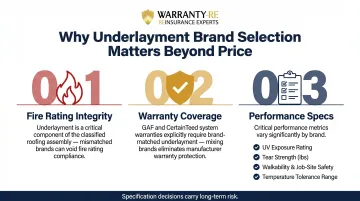
Picking the wrong underlayment brand can create problems well beyond a leaky roof. Three factors drive real risk for contractors:
- Fire rating integrity: ARMA confirms that an asphalt shingle alone carries no fire-resistance classification — the underlayment is part of the classified assembly. Swapping in a non-specified product can compromise the entire roof's fire rating.
- Warranty coverage: GAF's Lifetime Roofing System requires at least three qualifying GAF accessories (underlayment included). CertainTeed's Integrity Roof System matches underlayment warranty periods to the shingle — but only when CertainTeed products are used together. Non-approved substitutions can void enhanced coverage and expose contractors to liability.
- Performance specs: UV exposure ratings, tear strength, walkability, and temperature tolerance vary widely across brands. Choosing on price alone risks missing critical specs the job actually demands.
The brands covered below were evaluated on tear strength, UV resistance, system warranty compatibility, and real-world contractor use — not just price.
Top Roofing Underlayment Brands for Contractors
The five brands below cover the widest range of roofing applications, from standard asphalt shingle work to metal, slate, and high-temperature installations. Each entry breaks down product range, key performance specs, and where each brand performs best—so you can match the right underlayment to the job.
GAF
GAF is one of the most recognized names in North American roofing, with a full product line built to integrate with its Lifetime Roofing System. The lineup runs from FeltBuster (entry-level synthetic) through Tiger Paw (mid-grade) and Deck-Armor (premium breathable) to VersaShield (fire-resistant).
All GAF underlayments carry the Good Housekeeping Seal and qualify as components of the Lifetime Roofing System. GAF-certified contractors can offer extended system warranties when pairing GAF shingles with GAF underlayment—a real sales advantage on competitive bids.
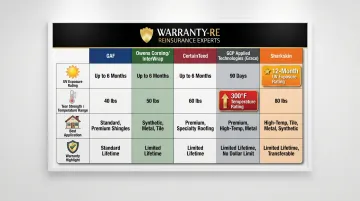
| Feature | Details | |---------|---------|| | Product Range | FeltBuster (90-day UV), Tiger Paw (180-day UV), Deck-Armor (180-day UV, breathable), VersaShield (60-day UV, fire-resistant) | | UV Exposure | 60 to 180 days depending on product | | Tear Strength | Tiger Paw and Deck-Armor: 600% greater than #30 felt (per ASTM D4533) | | Breathability | Deck-Armor: 16 perms (ASTM E96) | | Best Application | Asphalt shingle systems; Deck-Armor for moisture-sensitive or complex structures |
Owens Corning / InterWrap
Owens Corning acquired InterWrap in 2016 for $450 million, adding manufacturing capacity across the US, Canada, India, and China. The combined lineup spans DeckDefense (entry-level), ProArmor (mid-grade), RhinoRoof (premium), and the Titanium UDL series (UDL25, UDL30, UDL50) built for demanding applications.
The Titanium UDL series is the clear differentiator here. The Titanium UDL30 carries a 6-month UV rating and runs from -40°F to 240°F—specs that make it one of the stronger options for metal and tile work.
| Feature | Details | |---------|---------|| | Product Range | DeckDefense, ProArmor, RhinoRoof U20, Titanium UDL25/30/50, Titanium PSU30 (peel-and-stick) | | UV Exposure | DeckDefense: refer to installation instructions; Titanium UDL30: 6 months; UDL25/50: up to 180 days | | Strength Claims | Titanium UDL30: 50% stronger than premium competitive synthetics; UDL50: 2.5x stronger, 5x lighter than #30 felt | | Temperature Range | Titanium line: -40°F to 240°F | | Best Application | RhinoRoof/ProArmor for asphalt shingles; Titanium series for metal, tile, slate, and complex roofing systems |
CertainTeed
CertainTeed, a Saint-Gobain company, built its underlayment line to work within a full roofing ecosystem. RoofRunner handles entry-level applications, RoofRunner Air adds vapor permeability at mid-grade, and DiamondDeck covers premium installations. CertainTeed engineered these products to pair with its shingles for warranty integration.
RoofRunner Air delivers 15 perms breathability alongside weather protection—making it a practical choice for re-roofs in humid climates where moisture buildup under the deck is a real concern.
| Feature | Details | |---------|---------|| | Product Range | RoofRunner, RoofRunner Air, DiamondDeck | | UV Exposure | RoofRunner Air: 180 days; DiamondDeck: verify with technical data sheet | | Breathability | RoofRunner Air: 15 perms; RoofRunner and DiamondDeck: non-breathable | | Warranty Integration | Underlayment takes on the same warranty period as the shingle when used within the Integrity Roof System | | Best Application | RoofRunner Air for residential re-roofs with moisture concerns; DiamondDeck for specialty shingles or complex installations |
GCP Applied Technologies (Grace)
GCP Applied Technologies—originally part of W.R. Grace—built its reputation on peel-and-stick waterproofing. The product line covers Grace Ice & Water Shield (base), Grace Ultra (high-temp), Grace Select (mid-range peel-and-stick), and TRI-FLEX 15 (mechanically attached synthetic).
Two features set GCP apart. Grace Ice & Water Shield self-seals around nails and fasteners, making it the go-to for valleys, eaves, skylights, and pipe penetrations. Grace Ultra reaches 300°F service temperature using 100% butyl rubber with zero asphalt—the documented high-temperature leader for copper, zinc, and COR-TEN metal roofing.
| Feature | Details | |---------|---------|| | Product Range | TRI-FLEX 15 (mechanically attached), Grace Ice & Water Shield, Grace Ultra, Grace Select (all peel-and-stick) | | UV Exposure | Grace Select: 30 days; Grace Ice & Water Shield: 90 days; Grace Ultra: 120 days | | Thickness | Grace Select: 25 mil; Grace Ice & Water Shield: 40 mil; Grace Ultra: 30 mil | | Max Service Temp | Grace Ultra: 300°F (149°C) | | Best Application | Peel-and-stick line for valleys, eaves, high-risk zones; Grace Ultra for metal and tile requiring extreme temperature performance |
Sharkskin (Kirsch Building Products)
Founded in 2001 in Simi Valley, California, Kirsch Building Products makes the entire Sharkskin line in the USA—recyclable and VOC-free across the board. The lineup includes Sharkskin COMP and Ultra (mechanically attached), Ultra SA (peel-and-stick), and the Ventilated Roof Mat for applications where airflow beneath the roofing material matters.
Two things separate Sharkskin from the field. Ultra and Ultra SA carry 12-month UV ratings—the longest documented in this comparison. The Ventilated Roof Mat is also rare in this category, giving metal roofing contractors a purpose-built solution for managing heat and moisture between the panel and deck.
| Feature | Details | |---------|---------|| | Product Range | Sharkskin COMP (6-month UV), Ultra (12-month UV), Ultra SA (peel-and-stick, 12-month UV), Ultra Radiant, Ventilated Roof Mat | | UV Exposure | COMP: 6 months; Ultra, Ultra SA, Ultra Radiant: 12 months | | Temperature Range | Ultra and Ultra SA: -40°F to 280°F | | Warranty | Ultra SA: 50 years under metal, tile, or slate | | Best Application | Metal roofing, slate, clay/concrete tile; Ventilated Roof Mat for metal panel systems requiring thermal management |
What to Look for When Choosing a Roofing Underlayment Brand
A common contractor mistake is selecting underlayment purely on unit price—without factoring in UV exposure rating, ASTM testing compliance, and whether the product is approved for the specific roof type being installed.
Key Selection Factors:
- UV Exposure Rating: How long can the underlayment remain exposed during installation? Ratings range from 30 days (Grace Select) to 12 months (Sharkskin Ultra). Projects with delayed roofing material installation require higher UV ratings
- ASTM Compliance: Verify the product meets the relevant standard—ASTM D226/D4869 for felt, D8257 for synthetic, D1970 for peel-and-stick
- Roof Compatibility: Not all underlayments work with all roofing materials. Metal roofing requires high-temperature-rated products; tile and slate need products rated for mechanically attached applications
- Warranty System Integration: Check whether the shingle or panel manufacturer requires brand-matched underlayment for extended warranties
Overlooked Warranty Consequences:
Underlayment brand compatibility with the roofing system manufacturer's warranty is an area contractors often overlook. GAF's Lifetime Roofing System requires at least three qualifying GAF accessories—underlayment counts. CertainTeed's Integrity Roof System extends underlayment warranty periods to match the shingle only when CertainTeed underlayment is used.
Using unapproved underlayment can void enhanced coverage and expose contractors to homeowner claims.
Operational Factors:
- Choose roll sizes and weights your crew can handle efficiently without slowing installation
- Confirm distributor stock levels before committing—lead times vary significantly by brand and region
- Look for manufacturers that offer a technical hotline and detailed installation documentation
- Prioritize brands that provide training materials your team can reference on the job
Conclusion
Underlayment brand selection directly affects installation quality, warranty eligibility, claims exposure, and your long-term reputation with homeowners. Contractors who choose underlayment based solely on price risk callbacks, voided warranties, and customer dissatisfaction.
Evaluate brands against your most common project types, climate conditions, and the shingle or panel manufacturer's approved product list before committing to a supplier. A few clear leaders emerge for specific use cases:
- Extended UV exposure windows: Sharkskin's 12-month rating gives crews the most installation flexibility of any option reviewed
- System warranty integration: GAF and CertainTeed provide the clearest pathways to enhanced coverage tied to their shingle systems
- Peel-and-stick in extreme temperatures: Grace Ultra's 300°F rating sets the benchmark for high-heat applications
Contractors who invest in quality materials and build a strong track record of durable installations are well positioned to offer their own warranty programs and capture the profits that come with them. WarrantyRE helps roofing contractors set up reinsurance-backed warranty programs that turn every quality installation into recurring revenue and protect the business from unexpected claims exposure.
Frequently Asked Questions
Who makes the best roof underlayment?
No single brand is universally best. GAF, Owens Corning, CertainTeed, and GCP Applied Technologies are among the most widely used, but the right choice depends on roofing material type, climate, and warranty system requirements.
What do roofers use for underlayment?
Most residential roofers use synthetic underlayment — GAF Tiger Paw, Owens Corning ProArmor, and CertainTeed RoofRunner are common choices for standard asphalt shingle work. Peel-and-stick products like Grace Ice & Water Shield cover high-risk zones such as valleys and eaves.
Are all synthetic underlayments the same?
No. Most synthetics use polypropylene or polyethylene, but they vary in thickness, tear resistance, UV rating, walkability, and roofing compatibility. Always compare spec sheets before selecting.
What is the longest lasting roof underlayment?
Peel-and-stick rubberized asphalt underlayments (like Grace Ice & Water Shield) and premium synthetic options offer the longest service life. Sharkskin Ultra and Ultra SA are rated to remain exposed for up to 12 months during construction—the longest documented UV exposure window.
What is the difference between felt and synthetic underlayment?
Felt is paper or fiberglass mat saturated in asphalt — affordable, but prone to tearing and moisture absorption. Synthetic underlayment (woven or non-woven polypropylene) offers up to 600% greater tear resistance, lighter weight, and better UV stability.
Does underlayment brand affect roof warranties?
Yes. Many roofing system manufacturers (including GAF and CertainTeed) require contractors to use approved, brand-matched underlayments to qualify for extended or lifetime system warranties. Using unapproved underlayment can void homeowner coverage and expose contractors to claim liability.