A roofing CRM (Customer Relationship Management system) eliminates this chaos by centralizing leads, estimates, job schedules, and customer communications in one platform. This post covers what a roofing CRM actually is, the key features that separate specialized tools from generic ones, and a breakdown of the top five platforms roofing contractors use today.
TL;DR
- Roofing-specific CRMs centralize lead tracking, job management, estimating, and customer communications in one platform
- General CRMs lack aerial measurement integrations, contractor estimating templates, and job-site documentation tools
- The best options combine pipeline management, mobile field access, spec-based estimating, and real-time reporting
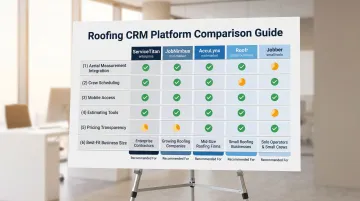
- Top platforms include ServiceTitan, JobNimbus, AccuLynx, Roofr, and Jobber — each suited to different business sizes
- Pick based on team size, which features you'll actually use, and whether the platform can scale with you
What Is a Roofing CRM — and Why Do Contractors Need One?
A roofing CRM is Customer Relationship Management software built specifically for roofing and exterior contracting businesses. According to Salesforce, CRM is "a system that helps businesses manage all interactions with customers and prospects to improve relationships, streamline processes, and drive growth." For roofers, this means centralizing lead tracking, customer data, job management, communications, estimates, and invoicing in one platform rather than across disconnected spreadsheets, sticky notes, and email threads.
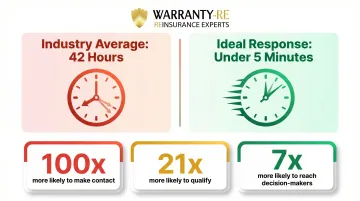
The operational impact is real. Leads contacted within 5 minutes are 100x more likely to make contact and 21x more likely to be qualified than leads contacted after 30 minutes. Companies responding within one hour are 7x more likely to have meaningful conversations with decision-makers.
Yet the average response time in the home service industry is 42 hours — nearly two full business days. A CRM closes that gap by automating lead notifications, tracking follow-up tasks, and making sure no opportunity slips through.
Why general CRMs fall short for roofers:
Platforms like Salesforce, HubSpot, or Zoho are powerful — but they're built for generic business processes, not roofing workflows. They don't include:
- Aerial roof measurement integrations (EagleView, GAF QuickMeasure, Hover)
- Job-site photo documentation and progress tracking
- Seasonal scheduling that accounts for weather delays
- Contractor-specific estimating workflows with material calculations
- Supplier integrations for real-time material ordering (ABC Supply, SRS Distribution)
Adapting a general CRM to handle these functions means paying for costly customization, managing third-party integrations, and absorbing ongoing maintenance costs. In most cases, that ends up more expensive than a roofing-specific platform and delivers a worse experience for your team.
Best Roofing CRM Software for Contractors
These five platforms were selected based on roofing-specific functionality, user adoption, integration depth, and scalability across contractor business sizes.
ServiceTitan
ServiceTitan is an all-in-one field service management and CRM platform built for home service trades including roofing. Mid-to-large contractors use it for a complete platform covering CRM, dispatching, estimating, accounting, and marketing analytics. Over 7,500 contractors use ServiceTitan across all trades, with the company reporting that switching to the platform increased average revenue by 21% in contractors' first two years.
What makes it stand out:
- Sales pipeline management with opportunity tracking and stage-based workflows
- Spec-based estimating with automated material calculations
- EagleView and GAF QuickMeasure aerial measurement integrations — order reports directly within ServiceTitan
- Real-time marketing ROI reporting tied directly to bookings and revenue
- Insurance claims workflows with Xactimate sync
- Supplier integrations with ABC Supply, QXO, and SRS Distribution
- Financing through GreenSky, GoodLeap, ServiceFinance, and Synchrony
ServiceTitan is positioned as a Preferred CRM of GAF, with eligible GAF Master Elite Contractors receiving a 3% rebate on subscriptions.
| Best For | Mid-size to enterprise roofing companies needing an all-in-one operations platform |
|---|---|
| Key Features | Pipeline management, crew scheduling, spec-based estimating, mobile field app, marketing ROI tracking |
| Pricing | Custom quotes based on business needs; not publicly published. Contact ServiceTitan for pricing. |
JobNimbus
JobNimbus is a cloud-based CRM and project management platform used by over 6,000 roofing contractors. It combines lead organization, workflow automation, and billing tools — without the complexity of enterprise platforms.
Standout features:
- Customizable Kanban-style "Boards" for tracking jobs across sales, production, and cash flow stages
- Integrated billing with automated payment collection
- QuickBooks Online and Desktop sync to reduce double entry between systems
- Workflow automation that triggers tasks, reminders, and follow-ups based on job stage changes
- Mobile access for field teams to update job statuses, capture photos, and communicate with customers
JobNimbus offers four pricing tiers (Essentials, Pro, Premium, Enterprise) based on user count, but actual dollar pricing is not publicly published. All plans include unlimited contacts, estimates, documents, e-signatures, invoices, and mobile app access. A 14-day free trial is available with no credit card required.
| Best For | Small to mid-size roofing companies wanting workflow automation and project visibility |
|---|---|
| Key Features | Customizable pipeline boards, workflow automation, billing, mobile access, QuickBooks integration |
| Pricing | Custom quotes by business size and workflow needs; contact JobNimbus for pricing. |
AccuLynx
AccuLynx is one of the longest-standing platforms built exclusively for roofing contractors, founded in 2008. It covers the full job lifecycle from lead capture to final invoice, with deep supplier integrations and contractor-specific tools.
Key differentiators:
- Aerial measurement-to-estimate conversion in seconds via EagleView, GAF QuickMeasure, Hover, RoofSnap, and Geospan integrations
- Built-in customer portal where homeowners can track job progress
- In-app crew scheduling with shared calendars and real-time availability views
- AccuFi financing (powered by Acorn Finance) for instant homeowner pre-approval and real-time loan status updates
- Real-time material ordering through ABC Supply, QXO, and SRS Distribution directly within the platform
- In-app messaging with live activity feeds to keep office and field teams aligned
- Storm tracking via HailWatch and CoreLogic Hail Maps integrations
- QuickBooks and Sage Intacct sync for accounting
AccuLynx is one of the few platforms where every feature — from storm tracking to supplier ordering — was built for roofing, not retrofitted from a general tool.
| Best For | Roofing contractors who want a purpose-built platform with deep supplier and measurement integrations |
|---|---|
| Key Features | Aerial estimating, AccuFi financing, crew scheduling, customer portal, QuickBooks sync, e-signatures |
| Pricing | Not publicly published; contact AccuLynx for custom pricing. |
Roofr
Founded in 2016 by third-generation roofer Richard Nelson, Roofr started as a roof measurement and proposal tool and has grown into a full CRM covering the sales process end to end. It's built around speed — fast measurements, fast proposals, fast closes.
What sets it apart:
- Instant estimating from satellite measurements with 2-hour or 24-hour delivery options
- Custom digital proposals with e-signature capability to close deals faster
- Transparent tiered pricing that scales from solo operators to growing teams
- Product roadmap driven by direct contractor feedback, making it well-suited for growth-focused smaller to mid-size teams
- QuickBooks integration (available on Scale plan)
- Crew management, job costing, and performance dashboards (available on Scale plan)
Roofr offers three pricing tiers:
- Starter: $0/month (measurement reports $19 each, 24-hour delivery; 1 basic job board; 10 trial proposals/invoices; material ordering)
- Essentials: $249/month or $209/month annually (measurement reports $13 each, 2-hour delivery; 1 flexible job board; unlimited proposals/invoices; credit card and ACH payments; SMS texting)
- Scale: $349/month or $299/month annually (3+ customizable job boards; custom job tags; crew management; 25+ automated actions; performance dashboard; profit margins and job costs; QuickBooks integration)
Add-ons include Instant Estimator at $149/month and Measure+ at $109–$169/month.
| Best For | Small to growing roofing companies prioritizing fast, accurate estimates and a modern sales workflow |
|---|---|
| Key Features | Instant estimates, satellite roof measurements, digital proposals with e-signature, payments and invoicing, CRM pipeline |
| Pricing | Starter: $0/month; Essentials: $249/month ($209/month annually); Scale: $349/month ($299/month annually) |
Jobber
Jobber is a field service management platform serving home service businesses broadly, including roofing. It's a practical choice for contractors who want professional quoting, crew scheduling, and client management without enterprise-level complexity.
Value for roofing contractors:
- EagleView integration pulls aerial roof measurements directly into estimates (Connect, Grow, and Plus plans; first 5 reports free for new users, up to $450 value)
- Drag-and-drop scheduling with visual calendar management
- Client communication hub with automated reminders, two-way SMS, and service history tracking
- GPS tracking and route optimization via FleetSharp integration
- QuickBooks Online and Xero sync for accounting
Jobber's pricing scales from solo operators to small crews:
- Core: $49/month (1 user; online booking, scheduling, quotes, invoices, payments)
- Connect: $139/month (1 user; adds automated reminders, automatic payment collection, QuickBooks Online sync)
- Grow: $199/month (1 user; adds advanced quote customizations, job costing, two-way SMS, workflow automations)
- Plus: $699/month (15 users; adds Marketing Suite, AI Receptionist, Pipeline lead tracking, premium support)
A 14-day free trial is available with no credit card required.
| Best For | Solo roofers and small roofing crews wanting an approachable, scalable platform with strong scheduling |
|---|---|
| Key Features | EagleView integration, drag-and-drop scheduling, client hub, GPS tracking, QuickBooks and Xero sync |
| Pricing | Core: $49/month; Connect: $139/month; Grow: $199/month; Plus: $699/month (15 users) |
Key Features to Look for in a Roofing CRM
Not every CRM is built for contractors. The five capabilities below separate roofing-specific platforms from generic tools — and directly affect how fast your team closes jobs.
Lead and Pipeline Management
Roofing businesses depend on consistent lead flow, and 35-50% of sales go to the vendor that responds first. Your CRM should let reps track leads from first contact through proposal, follow-up, and close — with clear pipeline stages so no opportunity falls through. Look for:
- Automatic lead capture from web forms, phone calls, and third-party sources
- Stage-based workflows (new lead → estimate sent → proposal → closed won/lost)
- Automated follow-up reminders triggered by inactivity or stage changes
- Lead source tracking to measure which marketing channels deliver the best ROI
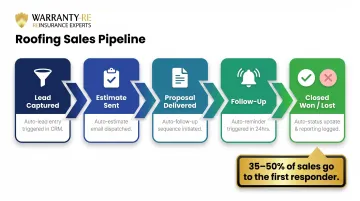
The difference between a 30% and 50% close rate often comes down to who follows up — and how fast.
Estimating and Proposal Tools
Converting a roof measurement into a branded, signed proposal in the same appointment is something generic CRMs can't do. Roofing-specific estimating tools close that gap.
Key capabilities:
- Integration with aerial measurement services (EagleView, GAF QuickMeasure, Hover)
- Spec-based estimating with automated material quantities and pricing
- Customizable proposal templates with photos, scope of work, and payment terms
- E-signature capability for on-the-spot contract signing
- Real-time pricing updates from supplier integrations
EagleView claims 98.77% accuracy validated in independent studies, eliminating the need for onsite visits for initial measurements.
Job Scheduling and Crew Management
Roofing requires coordinating multiple crews, managing weather delays, and tracking multi-day projects. Your CRM should support:
- Drag-and-drop calendars with real-time crew availability
- Crew assignments with job details, customer information, and location
- Weather delay tracking and rescheduling workflows
- Shared calendars visible to office staff and field teams
- Route optimization to minimize drive time between jobs
When scheduling breaks down, crews show up to the wrong job or sit idle — and customers notice.
Mobile Field Access
62% of organizations have adopted CRM for field service operations — and in roofing, where crews spend the day on-site rather than in front of a computer, mobile access isn't optional. Your CRM's mobile app must let field teams:
- View daily schedules and job details
- Capture photos and document job progress
- Update job statuses in real time
- Communicate directly with customers via SMS or in-app messaging
- Collect payments and signatures on-site
A mobile-ready CRM cuts the back-and-forth calls and keeps job data accurate without requiring crews to re-enter information at the end of the day.
Reporting and Marketing ROI
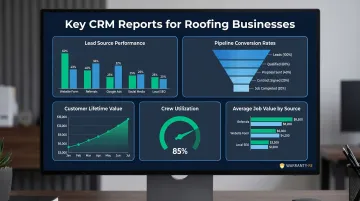
Knowing which leads came from which source — and what revenue they generated — is essential for scaling a roofing business. Look for CRMs that tie marketing spend directly to bookings and closed revenue.
Critical reports:
- Lead source performance (Google Ads, direct mail, referrals, storm tracking)
- Sales pipeline conversion rates by stage
- Average job value and close rates by lead source
- Crew utilization and job profitability
- Customer lifetime value and repeat business rates
ServiceTitan's 2024 Exterior Trades Report found that 27% of contractors identified "increasing technology usage" as a key way to boost revenue through operational efficiency. Real-time reporting makes that possible.
How We Chose the Best Roofing CRM Software
Not all CRM software is built for roofing. Our evaluation focused on four criteria that matter most to contractors:
- Roofing-specific functionality (not retrofitted generic features)
- Integration depth with measurement tools like EagleView and accounting platforms like QuickBooks
- Mobile usability for field teams working on-site
- Proven adoption at scale within the roofing industry
Common mistakes contractors make when choosing CRM software:
Going with the cheapest option without auditing which features they actually need. A $49/month platform that doesn't integrate with EagleView or QuickBooks will cost more in wasted time than a $249/month platform that handles both.
Defaulting to general-purpose CRMs like Salesforce or HubSpot. These platforms can handle roofing workflows, but adapting them costs thousands in consulting fees and ongoing maintenance. About one-third of CRM projects fail, often because of over-budget implementations and poor fit.
Ignoring scalability. A solo roofer running 50 jobs a year has different needs than a 10-person crew running 300. The right platform fits current operations and grows with the business — no painful migration required.
The right CRM depends on business stage. A solo operator benefits from Jobber's simplicity and $49/month entry point. A 20-person roofing company needs ServiceTitan's dispatching, marketing analytics, and multi-crew scheduling. Match your choice to where you are now — and where you realistically expect to be in two years.
Conclusion
The best roofing CRM is the one that actually gets used. It should reduce administrative burden, give your team visibility into the sales pipeline, and integrate with the tools already in your workflow. Prioritize fit over brand recognition or feature volume. A simpler platform your team uses daily beats a complex one that sits idle.
A CRM manages the customer relationship and operational workflow, but contractors who want to capture more profit from every job should also look beyond software. WarrantyRE's contractor reinsurance model helps roofing businesses turn completed installations into a recurring revenue stream while reducing the financial risk of warranty claims.
WarrantyRE helps roofing contractors establish their own tax-advantaged reinsurance company, capturing underwriting profits from labor warranties instead of paying third-party providers. When you include a labor warranty in your job pricing, the fee flows into your own reinsurance account rather than to an external company.
WarrantyRE handles the administrative side so you can stay focused on roofing work:
- Claims administration and adjudication
- Compliance management and legal filings
- Financial reporting and bookkeeping
The result is a controlled profit center that generates recurring revenue from work you're already doing.
Reach out to WarrantyRE to learn how CRM software and contractor reinsurance can work together to build a more profitable roofing business.
Frequently Asked Questions
What is a CRM for roofing companies?
A roofing CRM is software that centralizes customer data, lead tracking, job management, and communications for roofing contractors. Roofing-specific versions include tools like aerial measurement integrations, contractor estimating workflows, crew scheduling, and supplier ordering — features not found in generic CRMs.
What are the best roofing CRM software options?
The top options are ServiceTitan, JobNimbus, AccuLynx, Roofr, and Jobber. The best choice depends on your company size, required features, and budget. - ServiceTitan — mid-to-large operations
- JobNimbus / AccuLynx — mid-market contractors
- Roofr — growth-focused smaller teams
- Jobber — solo roofers and small crews
What features should I look for in a roofing CRM?
Prioritize these five features:
- Lead and pipeline management with automated follow-ups
- Roofing-specific estimating with aerial measurement integrations
- Crew scheduling with drag-and-drop calendars
- Mobile field access for on-site updates
- Reporting tied to revenue outcomes and marketing ROI
Is a general CRM like HubSpot or Salesforce good enough for roofing contractors?
General CRMs lack roofing-specific features like measurement integrations (EagleView, GAF QuickMeasure), job-site photo documentation, contractor estimating templates, and supplier ordering. Most roofing businesses benefit far more from purpose-built tools that require no customization to handle roofing workflows.
How much does roofing CRM software typically cost?
Pricing varies widely by platform and business size. Solo plans start around $49/month (Jobber Core) and scale to $700+/month for multi-user enterprise platforms. Mid-market options range from $200-$350/month. ServiceTitan, AccuLynx, and JobNimbus offer custom pricing based on business needs. Most platforms offer free trials to test functionality before committing.
Can a roofing CRM help manage service agreements and warranties?
Some CRMs include service agreement tracking and recurring job scheduling for warranty callbacks. Formal warranty program management is a separate function. Contractor-owned reinsurance structures — which capture underwriting profits through claims administration, regulatory compliance, and tax-advantaged company setup — require specialized providers like WarrantyRE.