Introduction
For HVAC contractors, equipment brand selection determines far more than what goes on the curb or in the mechanical room. The brands you install directly shape your callback rates, warranty liability, customer satisfaction scores, and job profitability. Many contractors struggle with balancing equipment quality against dealer program support, parts availability, and pricing flexibility—all while trying to build a reputation that drives referrals and repeat business.
The U.S. HVAC market is more concentrated than most realize. Approximately 90% of residential units are shipped by just eight companies: Carrier, Daikin, Rheem, Trane, Bosch, Lennox, Mitsubishi Electric Trane HVAC US, and Nortek. These manufacturers control dozens of brand names, meaning contractors who understand the parent-company landscape can make better decisions that protect margins and reduce warranty risk.
This guide evaluates the top HVAC equipment brands from a contractor's business perspective: dealer program quality, parts networks, warranty structures, and product range. Use it to choose brands that protect your margins and reduce callbacks, not just win the bid.
TLDR
- Brand choice directly impacts contractor margins, callback frequency, and customer loyalty
- Eight manufacturers control 90% of U.S. HVAC shipments under dozens of brand names
- Premium brands (Carrier, Trane, Lennox) offer strong dealer support networks and broad brand recognition
- Budget-focused jobs are well-served by value brands (Goodman, Ruud) with competitive pricing and lower upfront cost
- Contractors can also establish their own reinsurance programs to keep underwriting profits in-house rather than paying third-party providers
Why Brand Selection Matters for HVAC Contractors
While manufacturers share many common components across brands—Trane and American Standard share production facilities; Goodman and Amana come from the same Waller, TX plant—meaningful differences exist in dealer support, warranty fulfillment speed, parts availability, and certification requirements. All of these directly affect your bottom line.
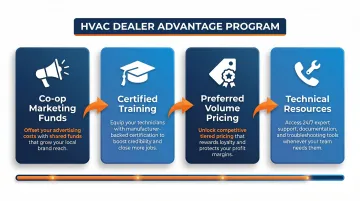
A brand with poor parts availability or slow warranty claim processing drives up labor costs on every callback and frustrates customers who expect fast resolution. Strong dealer programs flip that equation with tangible business advantages:
- Co-op marketing funds that offset customer acquisition costs
- Certified training that qualifies your team for higher-margin installs
- Preferred volume pricing that improves job-level margins
- Technical resources that reduce time-on-site for complex calls
The brands below are evaluated through a contractor lens: product reliability, dealer program strength, parts distribution networks, warranty terms, and equipment breadth across residential and light commercial applications.
Top HVAC Equipment Brands for Contractors to Install
These brands were selected based on product reliability, dealer program quality, parts availability, warranty terms, and product range across residential and commercial applications.
Carrier
Carrier pioneered modern air conditioning in 1902 and remains one of the largest HVAC manufacturers in the U.S. by revenue. The company reported $22.5 billion in net sales for 2024. Carrier operates across residential, commercial, and building automation segments under multiple sub-brands including Bryant, Payne, Comfortmaker, Day & Night, Heil, and Arcoaire.
What makes Carrier stand out for contractors: An extensive authorized dealer network through Carrier Enterprise, co-op marketing support, access to Carrier University training programs, and wide product breadth from budget-tier Payne systems to premium Infinity Series equipment. This range lets contractors serve diverse customer segments without changing distributors.
| Category | Details |
|---|---|
| Product Lines | Infinity (premium), Performance (mid-tier), Comfort (value); ductless, packaged units, variable-speed systems |
| Dealer Program | Factory Authorized Dealer program with training through Carrier University, co-op marketing funds, exclusive dealer tiers, and factory-backed satisfaction guarantee |
| Warranty Terms | Consumer Choice Warranty: 10-year parts or 5-year parts + 3-year labor with timely registration; 5-year parts unregistered |
Trane
Trane was founded in 1885 in La Crosse, WI and operates under Trane Technologies alongside American Standard and RunTru. The brand is known for rigorous reliability testing, a wide national dealer network, and strong parts distribution.
What sets Trane apart for contractors: Strong brand recognition helps close sales, durable build quality reduces callbacks, and the Trane ComfortSite portal provides contractors with online resources, warranty registration tools, and technical support. Trane's Comfort Specialist dealer program offers tiered benefits including training, marketing support, and preferred pricing.
| Category | Details |
|---|---|
| Product Lines | XR (value), XL (mid-tier), XV (premium); traditional split systems, packaged systems, ductless mini-splits |
| Dealer Program | Trane Comfort Specialist program with ComfortSite portal access, training resources, co-op funds, and Charter Member recognition |
| Warranty Terms | 5-year base; 10-year parts with registration within 60 days; compressor coverage varies by series (10-year XR, 12-year XV/XL); labor not included unless optional plan purchased |
Lennox
Founded in 1895 and headquartered in Richardson, TX, Lennox focuses on high-efficiency residential and light commercial HVAC. The brand runs a tiered product structure (Merit, Elite, Signature) and is known for strong energy efficiency ratings and proprietary Quantum Coil technology for corrosion resistance.
Why contractors benefit: Lennox Stores (formerly PartsPlus) operate 200+ locations across 42 states with dedicated brand-only distribution and 24/7 technical support. The iComfort smart thermostat ecosystem supports upsells to tech-savvy customers, and premium Signature Series units command higher ticket values.
| Category | Details |
|---|---|
| Product Lines | Dave Lennox Signature Collection (premium), Elite Series (mid-tier), Merit Series (value); commercial rooftops, ductless mini-splits |
| Dealer Program | LennoxPROs portal access, exclusive distribution through Lennox Stores, certified dealer training, co-op marketing support |
| Warranty Terms | Signature: 10-year components/compressor, 20-year or Limited Lifetime heat exchanger; Elite: 5-year components, 10-year compressor; Merit: 5-year components/compressor; Extended warranty and Comfort Shield labor options available |
Daikin (Including Goodman)
Daikin Industries, headquartered in Osaka, Japan, acquired Goodman in 2012 and operates a 4.2-million-square-foot manufacturing facility in Waller, TX—the largest HVAC building in the U.S. This acquisition gives contractors access to both the premium Daikin brand and the budget-friendly Goodman line, which is among the most widely installed brands for value-focused residential work.
Why this brand family attracts contractors: Goodman offers competitive pricing with solid warranty coverage that helps win cost-sensitive bids. Daikin's inverter and VRF technology opens the door to higher-margin commercial and zoning projects. Both lines are widely stocked by major distributors.
| Category | Details |
|---|---|
| Product Lines | Daikin: AURORA concealed ducted inverter systems, Daikin Fit, VRF; Goodman: standard residential split systems, packaged units; Amana: premium-within-budget tier |
| Dealer Program | Daikin dealer certification tiers; Goodman available through multi-brand distributors with volume pricing incentives |
| Warranty Terms | Goodman: 5-year parts unregistered, 10-year parts with registration; select models include 10-year unit replacement and lifetime compressor for original owner |
Rheem (Including Ruud)
Founded in 1925 and headquartered in Atlanta, GA, Rheem Manufacturing is a strong mid-market HVAC brand popular with contractors for its balance of affordability, product breadth, and reliability. The Ruud brand serves the contractor channel while Rheem targets both wholesale and retail markets.
Rheem/Ruud draws contractors with competitive equipment pricing, low reported repair rates, and wide distribution through Ferguson, Gemaire, and Baker Distributing. The product lineup spans furnaces, heat pumps, packaged units, ductless, and water heaters — making it a strong single-brand solution for mixed-service shops.
The EcoNet smart monitoring integration and partnership with ecobee thermostats also create natural upsell opportunities on higher-margin installs.
| Category | Details |
|---|---|
| Product Lines | Endeavor line: Prestige, Classic Plus, Classic tiers; gas furnaces, air conditioners, heat pumps, air handlers, packaged systems, ductless |
| Dealer Program | Rheem Pro Partner program, training resources, multi-brand wholesaler access |
| Warranty Terms | Up to 10-year parts, up to 10-year conditional unit replacement, up to Limited Lifetime heat exchanger on select models; Protection Plus extended service contracts available through Equiguard |
How We Chose the Best HVAC Brands for Contractors
The brands above were evaluated on factors that directly affect contractor profitability—not consumer advertising budgets. Too many contractors default to price or personal familiarity, overlooking the full business relationship: dealer program strength, parts lead times, and how smoothly warranty claims actually get processed.
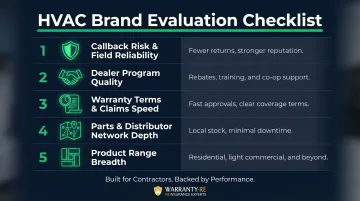
Key evaluation criteria:
- Callback risk and field reliability — does this equipment hold up after the install truck leaves?
- Dealer program quality — training access, co-op funds, preferred pricing, and technical support
- Warranty terms and claims speed — coverage duration, registration requirements, and how fast reimbursements arrive
- Parts and distributor network depth — regional stock availability and realistic lead times
- Product range breadth — serving both residential and commercial customers across budget tiers
These criteria cover the equipment decision — but contractor profitability extends past the sale itself. HVAC contractors who run their own warranty programs through a reinsurance structure keep the underwriting profits that would otherwise go straight to third-party providers. That revenue layer works regardless of which brand you're installing.
Conclusion
The best HVAC brand for your contractor business isn't the most advertised name—it's the brand whose dealer program, parts network, warranty support, and product range best align with your customer base, service area, and business model.
As your business grows, evaluate brands on scalability and ongoing support. Training access, co-op marketing, and reliable distributor relationships matter as much as equipment quality when you're scaling from 200 installs per year to 500+.
Brand selection drives install quality — but every install also generates warranty revenue that most contractors hand off to third-party providers. WarrantyRE helps HVAC contractors set up their own reinsurance company, keeping those underwriting profits in-house instead of paying them out. To learn more, reach out at (804) 824-9533.
Frequently Asked Questions
What are the most reliable HVAC brands?
Trane, Carrier, Lennox, and Rheem are consistently rated for reliability in contractor and industry surveys. However, field reliability depends heavily on proper installation and regular maintenance, not brand alone.
What are the builder-grade HVAC brands?
Builder-grade brands include Goodman, Payne, Comfortmaker, RunTru, and Ameristar. These are value-tier lines often from the same parent manufacturers as premium brands, designed for new construction budgets where cost sensitivity is high.
Who is the largest manufacturer of HVAC equipment?
Carrier Global Corp. is the largest U.S. HVAC manufacturer by revenue, reporting $22.5 billion in net sales for 2024. Daikin Industries is a leading global manufacturer. A small number of parent companies control most brand names in the market.
What should HVAC contractors look for in a dealer program?
Strong dealer programs typically offer:
- Certified training and technician support
- Co-op marketing funds
- Volume-based pricing tiers
- Warranty registration and claim tools
- Dedicated account support from the distributor or manufacturer
How do manufacturer warranties affect contractor liability?
Manufacturer warranties typically cover parts (often 10 years with registration) but do not cover labor. This means contractors bear labor costs on warranty callbacks unless they offer a separate labor warranty or extended service agreement to customers.
Is it better for HVAC contractors to carry one brand or multiple brands?
Single-brand exclusivity can earn better dealer program benefits and volume pricing, while multi-brand flexibility lets contractors match equipment to customer budgets and project types. Most successful contractors balance a primary brand relationship with access to secondary options for competitive bids.