

Georgia licenses plumbers under three distinct categories, each tied to a different scope of work. Insurance requirements touch all three, but county-level rules add their own layer on top of whatever the state requires — and those local thresholds can catch contractors off guard.
This guide covers the required insurance types, workers' compensation rules, surety bond obligations, county-level variations, and realistic cost benchmarks for plumbing contractors operating in Georgia.
TL;DR: Georgia Plumbing Contractor Insurance at a Glance
- General liability insurance is required for all licensed Georgia plumbing contractors
- Workers' compensation applies to any plumbing business with 3 or more employees
- Surety bond requirements vary by county and project type — there's no single statewide standard
- Commercial auto and tools coverage aren't state-mandated but are expected by commercial clients and necessary for daily operations
Georgia Plumbing License Types and What They Mean for Your Insurance
The Georgia Secretary of State's Division of Master and Journeyman Plumbers issues three license categories:
| License Type | Scope |
|---|---|
| Journeyman Plumber | Works under a licensed master plumber; requires 3 years of qualifying experience |
| Master Plumber Class I (Restricted) | Single-family homes, two-family dwellings, and commercial structures under 10,000 sq ft |
| Master Plumber Class II (Non-restricted) | Unrestricted — any residential or commercial plumbing work |
How License Class Affects Your Insurance Exposure
All three license types require proof of general liability insurance to obtain and maintain licensure. The practical insurance demands, however, scale with the work.
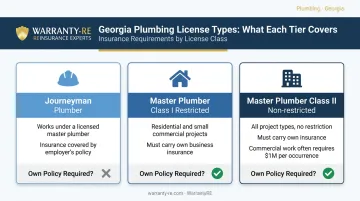
Class II contractors pursuing unrestricted commercial projects will routinely face contract-level requirements well above state minimums — general contractors and project owners typically require $1,000,000 per occurrence in general liability before they'll allow a subcontractor on-site.
Three practical distinctions apply:
- Journeyman plumbers working for a licensed business are generally covered under their employer's policy
- Master plumbers running their own company must carry their own business insurance — the employer's policy won't cover independent operations
- Insurance proof is required at the application stage — have coverage in place before you submit
For current documentation requirements tied to renewal and initial applications, verify directly with the Georgia SOS plumber licensing page.
Required Insurance for Georgia Plumbing Contractors
General Liability Insurance
Georgia requires all licensed contractors, including plumbers, to carry general liability insurance. A standard general liability policy covers:
- Third-party bodily injury (a client trips over your equipment)
- Third-party property damage (a pipe connection damages a customer's flooring)
- Completed operations liability (damage discovered after the job is finished)
That last one matters most for plumbers. Faulty pipe connections, water heater installations, and supply line work can fail days or weeks after a job closes. A completed operations claim hits after you're off the property — and if your policy excludes completed operations, you're personally exposed.
Confirm completed operations is included in your policy, not excluded. Some lower-cost policies carve it out.
Georgia SOS rules (121-2 through 121-4) and O.C.G.A. 43-14-6 do not set a single statewide dollar minimum for plumber general liability. Local requirements, however, do specify minimums — Augusta-Richmond County, for example, requires $50,000/$100,000 in general liability with the county named as certificate holder.
Workers' Compensation Insurance
Georgia's workers' compensation threshold for construction trades is lower than many contractors expect. Under Georgia State Board of Workers' Compensation rules:
- Employers with 3 or more employees (part-time or full-time) must carry workers' compensation coverage
- Sole proprietors and partners are not automatically employees and may elect coverage rather than being required to carry it
- Corporate officers and LLC members are generally treated as employees for coverage purposes
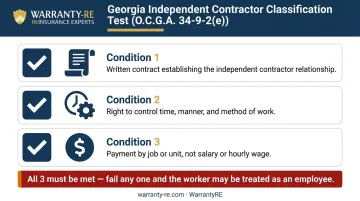
Watch the independent contractor classification: Georgia's definition under O.C.G.A. 34-9-2(e) requires a written contract establishing that relationship, the right to control time, manner, and method of work, and payment by job or unit rather than salary or hourly wage. All three conditions must be met — fall short on any one, and that "1099 subcontractor" may legally be an employee, and a workers' comp audit will treat them that way.
Georgia law sets civil penalties at $500 to $5,000 per occurrence for failing to carry required coverage, with potential misdemeanor charges for willful violations.
Certificate of Insurance (COI)
A COI is the standard proof-of-coverage document Georgia plumbing contractors must produce on demand. You'll need it for:
- License renewal submissions
- Local permit applications
- Commercial job site access (general contractors require it before work begins)
A COI lists your insurer, policy numbers, coverage types, limits, and effective dates. It is not a policy — it doesn't expand your coverage. Under Georgia OCI Bulletin 23-EX-9, a certificate cannot grant rights beyond what the underlying policy actually provides.
Keeping that COI current matters because the moment coverage lapses, the problems stack up quickly.
Consequences of a Coverage Lapse
- License suspension or inability to renew
- Inability to pull permits at the local level
- Disqualification from commercial bids
- Full personal financial exposure on any claims that arise during the lapse period
Surety Bond Requirements in Georgia
A surety bond is not insurance — it protects the client, not the contractor. If you fail to complete a job as contracted, the bond issuer pays the project owner (the obligee), then comes after you for reimbursement. Think of it as a financial backstop for your clients, not coverage for your own business.
Georgia has no single statewide surety bond requirement for plumbing contractors. Requirements are set entirely at the county and municipal level.
Local Bond Examples
| Jurisdiction | Residential Bond | Commercial Bond |
|---|---|---|
| Augusta-Richmond County | $15,000 | $20,000 |
| East Point | $10,000 (tradesmen bond) | N/A (per available docs) |
Augusta-Richmond County is one of the more thoroughly documented examples — their official plumbing contractor requirements specify the bond amounts above alongside the general liability thresholds.
Practical Rule for Georgia Plumbers
Before bidding in any new county or municipality, contact the local licensing authority to confirm current bond requirements. Bond amounts shift frequently, differ from one jurisdiction to the next, and aren't always easy to find online. A quick call before you bid is worth it.

A few things to keep in mind as you expand into new markets:
- Local bond minimums vary widely — what applies in Augusta won't apply in Savannah or Athens
- Government and public works projects typically carry bond requirements set by the contracting agency, often above county minimums
- Requirements aren't always published; direct contact with the licensing office is the most reliable source
Additional Insurance Georgia Plumbing Contractors Should Consider
Commercial Auto Insurance
Any vehicle used for business — transporting tools, materials, or crew to job sites — must be covered under a commercial auto policy. Personal auto policies exclude business use. A plumber who gets into an accident in their work truck while on the clock could be denied coverage entirely without a commercial policy in place.
Contractor's Tools and Equipment Insurance
Plumbers invest heavily in equipment: pipe threading machines, inspection cameras, hydro-jetting units, and specialty hand tools. A tools and equipment policy (often structured as an inland marine policy) covers:
- Theft from job sites or vehicles
- Damage in transit
- Loss of gear on-site
This coverage is frequently bundled with a business owner's policy or purchased as a standalone endorsement.
Warranty Reinsurance: Turning Labor Warranties Into a Financial Asset
Standard insurance covers what goes wrong unexpectedly. But plumbing contractors who offer labor warranties face a different exposure — the liability sits on their books for every job they close.
WarrantyRE helps plumbing contractors turn that warranty liability into a revenue stream they own. Rather than paying a third-party warranty company or absorbing callback costs out of pocket, contractors collect a warranty fee built into each estimate, which flows into a reinsurance structure they control.
When callbacks occur — a fitting fails, a water heater connection leaks, a solder joint gives out — the claim is paid through the reinsurance account. Unused funds stay with the contractor, and contributions carry significant tax advantages. It's a model designed for contractors who are already standing behind their work and want that commitment to generate a financial return.
How Much Does Plumbing Contractor Insurance Cost in Georgia?
General Liability
Cost depends on payroll size, annual revenue, type of work (residential vs. commercial, water supply vs. gas fitting), and claims history. Published benchmarks give a useful starting point:
- Insureon reports a $115/month median for plumbing contractors nationally (updated October 2025)
- Insureon's Georgia small-business general liability average: $47/month (not plumber-specific)
- The Hartford reports a general small-business average of $67/month or $810/year
A small residential plumbing operation will land closer to the lower end. A commercial-focused company with several employees and higher revenue will pay significantly more.
Workers' Compensation
Georgia workers' comp premiums are calculated using a rate per $100 of payroll. Key figures for plumbing contractors:
- NCCI class code: 5183 (the standard classification for plumbing work)
- Advisory loss cost: $1.25 per $100 of payroll effective March 1, 2025 (excludes expense provisions — carrier rates will be higher)
- Experience modification rate (EMR): rises with claims history, drops with a clean record, and directly affects your final premium
Surety Bonds
Bond costs are typically far lower than insurance premiums. Key pricing factors:
- Bond amount required by the jurisdiction
- Contractor's personal credit score
- Claims history on prior bonds
- Underwriting risk assessment
For context, broker-published pricing for the Augusta-Richmond County contractor bond runs around $100/year, though your actual cost will vary by credit profile and bond amount.
County and Local Insurance Requirements in Georgia
State SOS licensing sets the floor. Local permit requirements often raise it.
Many Georgia cities and counties impose their own insurance minimums for plumbing contractors pulling local permits. Requirements vary by jurisdiction — and some go well beyond what state SOS licensing mandates:
- Augusta-Richmond County: Requires $50,000/$100,000 general liability with the county listed as certificate holder, plus residential and commercial surety bond amounts. None of this appears in state SOS rules.
- East Point: Takes a documentation-first approach — their plumbing permit application requires a bond form or waiver/indemnification form as part of the permit package.
Commercial clients and general contractors set their own thresholds on top of local requirements. The standard commercial subcontractor expectation in Georgia is:
- $1,000,000 per occurrence general liability
- $2,000,000 aggregate general liability
- Workers' compensation at statutory limits
- Proof of coverage before any work begins on-site
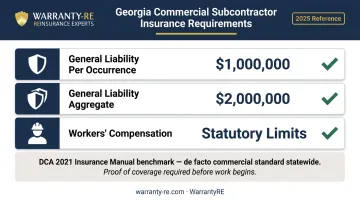
The Georgia Department of Community Affairs' 2021 Insurance Manual references $1,000,000 per occurrence and $2,000,000 aggregate as its construction contract benchmark — figures that have become the de facto commercial standard statewide.
Frequently Asked Questions
Do I need insurance before getting my Georgia plumbing license?
Yes. Georgia requires proof of general liability insurance as part of the licensing process for master plumbers. Have coverage in place before submitting your application — the state will not issue a license without it.
How much is liability insurance for a plumbing business in Georgia?
Costs vary by payroll, scope of work, and business size. A small residential operation might pay around $47–$115/month based on available market data, while larger commercial-focused businesses will pay more. Compare quotes from insurers who specialize in contractor coverage to get an accurate figure for your situation.
What type of insurance do 1099 plumbing subcontractors need?
Subcontractors typically need their own general liability policy. Workers' comp requirements follow Georgia law, not what the parties call the arrangement — O.C.G.A. 34-9-2(e) governs whether a worker is classified as an employee or contractor.
What surety bond amount is required for plumbing contractors in Georgia?
There's no single statewide amount. Augusta-Richmond County requires $15,000 for residential work and $20,000 for commercial — a useful example of how these vary. Always check with your specific county's licensing authority before starting work.
Does Georgia require workers' comp for a solo plumber with no employees?
Sole proprietors with no employees are generally exempt from Georgia's workers' compensation requirement. However, they still need general liability coverage and should verify their status if they use any subcontractors, since the state may treat those workers as employees.
What happens if my insurance lapses while I hold a Georgia plumbing license?
A lapse can trigger license suspension, block you from pulling permits, and disqualify you from commercial jobs. Under Georgia law, cancellation notice rights for certificate holders depend on whether you're named in the policy or a separate endorsement — review your policy terms carefully.